

Sixty years is a long time.
It is long enough for a college to change its name, a football field to acquire a new surface, and a generation of young men to become grandfathers. It is long enough for the world of college football to go from single-bar face masks and muddy fields to satellite television and instant replay.
But apparently, 60 years is not long enough to erase the memory of being a national champion.
That was evident when almost two dozen members of Waynesburg College’s legendary 1966 football team returned to town for a special reunion during Homecoming weekend. The team gathered Friday evening at The Denny House, then returned to campus Saturday to see the place where so much of their story began.
Perhaps the most remarkable part was the fact that so many of them came back.
For a group of men who played together in 1966, when a long-distance phone call was something you thought twice about making, the fact that teammates scattered across the country could once again find their way back to Waynesburg was something worth celebrating.
The setting at The Denny House seemed particularly appropriate. The beautifully restored Victorian home offered a little time travel of its own. The players didn’t need much help going backward in time, however. They had already spent the evening doing that.
There were the memories of practices, road trips, locker rooms and teammates who once seemed indestructible. There were undoubtedly those who have spent the past six decades improving his version of an old football story.
That is one of the privileges of getting older. The 1966 Yellow Jackets don’t have to agree on every detail anymore. They already agree on the important part. They were a team. And what a team they were.
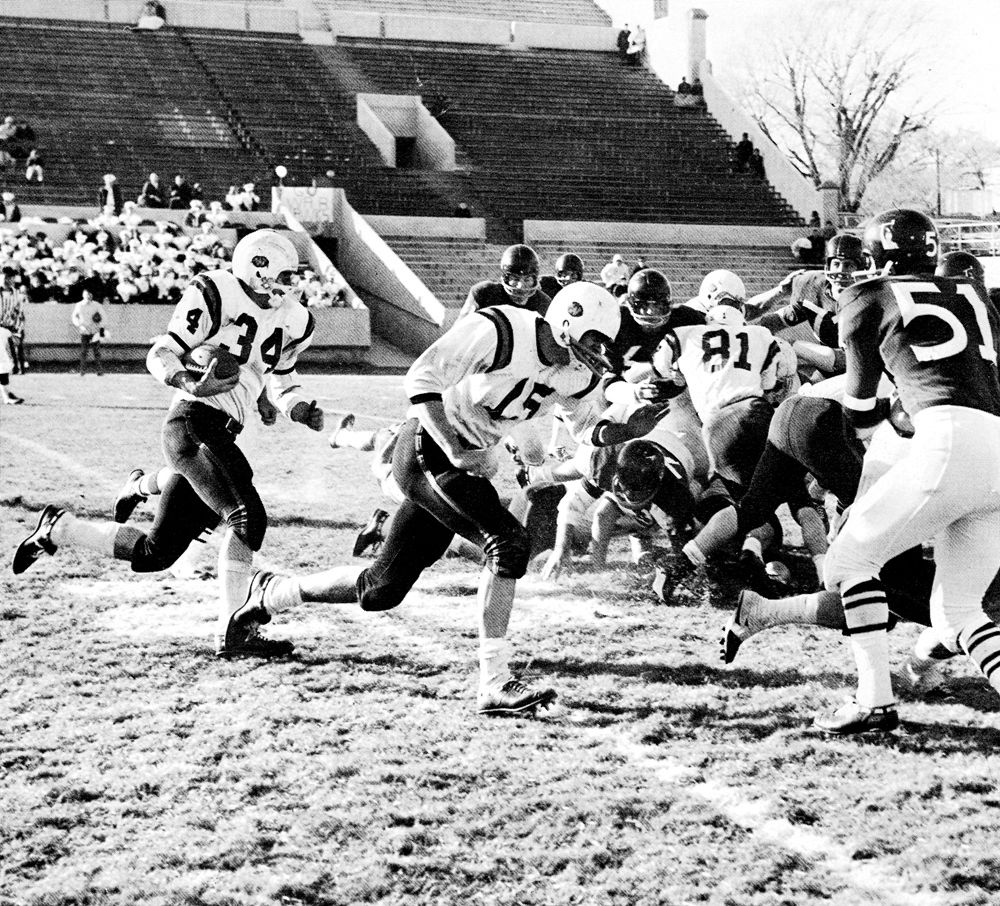
Under first-year head coach Carl DePasqua, Waynesburg went 11-0 and captured the NAIA National Championship. However, the season was more than a perfect record. It was one of those improbable sports stories that seems almost too good to be true when viewed from six decades away.
The Jackets were a very small college team made up largely of players from our region. There were no social-media posts or recruiting websites telling everybody how good the Yellow Jackets were supposed to be, especially because they weren’t supposed to be.
That’s because their new coach was replacing the legendary Mo Scarry who left to be an assistant coach with the Washington Redskins. In addition, the team brought in seven freshmen quarterbacks to try to replace two-way All-American Harry Theofiledes, who was also with the Redskins that season.
Eventually, Don Paul and John Huntly won the job and split time throughout the season. They had the advantage of throwing the ball to Don Hermann, who later spent seven years in the NFL with the New York Giants and the New Orleans Saints.
The defense was led by NAIA All-Americans Tim McNeil, Joe Hornack, and Beth-Center graduate Joe Righetti, who would go on to play for the Browns.
By the improbable season’s end, the team even had to choose between pursuing the NAIA championship and accepting a Tangerine Bowl invitation. Eventually, the Jackets chose the championship route—and history rewarded them for it.
In the semi-finals, they defeated a heavily favored (-28 points) New Mexico Highlands team that featured future AFL Rookie of the Year Carl Garrett at running back. After falling behind 20-0 in the second quarter, the Jackets fought back and won the game when Rich Dahar hit tight end Bob Miltenberger with a 5-yard halfback pass with 27 seconds left in the game. It was Miltenberger’s first TD catch of the season.
The team headed to Tulsa for the championship game and brought home the Amos Alonzo Stagg trophy after dominating Wisconsin Whitewater 42-21. Dahar carried the ball 41 times for a championship-game record 233 yards and three touchdowns.
They were greeted by 1,500 students and townsfolk in front of the courthouse, despite a pouring rain.
There were no cellphones to record the championship celebration. No streaming video. No digital photographs instantly appearing on thousands of screens. If you wanted to remember something, you remembered it. And these men remembered.
The reunion brought those memories back to a place that has changed considerably while remaining, in some ways, exactly the same. The old college has become a university. The football facility has evolved into John F. Wiley Stadium.
Yet on that Saturday, when the members of that championship team returned to campus and looked across the field, it was easy to imagine them as they were in 1966.
The university’s 2026 Homecoming included a special dedication of the renovated home locker room in honor of Coach DePasqua. The dedication was made possible by former player Dan Dvorchak, whose gift helped ensure that the coach’s name will remain connected to the program for generations to come.
So the weekend became more than a celebration of an old football season. It became a reminder that some victories don’t really belong to one season. They belong to the people who shared them.
Sixty years after the final whistle in Tulsa, those Yellow Jackets still have something in common. They still have the same championship on their résumés. They still have the same stories. And, judging by the number who made the trip back, they still have the same desire to see one another.
The players may have arrived in different cars, from different places and with more gray hair than they had in ‘66. But for a weekend in Waynesburg, they were Yellow Jackets again. And sometimes, after 60 years, that’s reason enough to come home.
Halfback Rich Dahar led the Jackets’ punishing run game.