

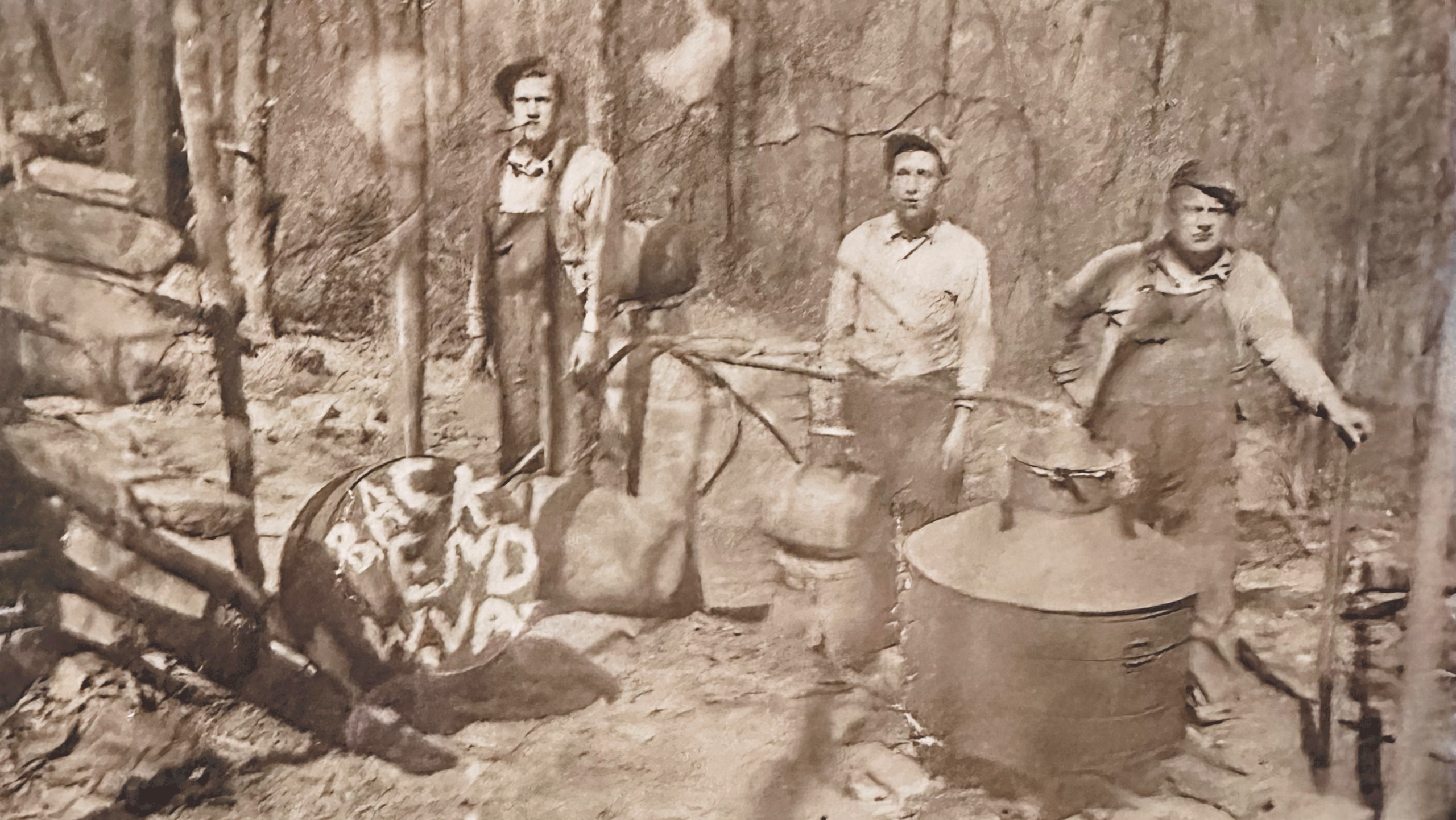
My grandfather (right with the shotgun) tending to his still in what was called the Back End in West Virginia.
There was a time, long ago, when life moved at a different pace in the hills surrounding Grafton, West Virginia. It was a time when family meant everything, neighbors looked out for one another, and the lessons passed down from one generation to the next were worth more than anything money could buy. Among those old traditions was the lost art of making moonshine, a craft woven into the history of Appalachia and remembered by many as a part of a way of life that has slowly faded into the past.
In those days, the hills of West Virginia held secrets of their own. The mountains rose and fell like waves across the countryside, and narrow dirt roads wound through hollows where families have lived for generations. Small cabins sat tucked among the trees, smoke curled from their chimneys on cold mornings, and the sound of a creek running over stones could be heard long before a traveler ever reached the front porch.
For some families, making moonshine was more than simply producing whiskey. It represented resourcefulness, hard work, and knowledge handed down through the years. In a region where good jobs were sometimes scarce and money was often tight, people learned to make use of what the land provided. Cornfields, spring water, and a deep understanding of the seasons were part of a tradition that demanded patience and experience. The old-timers knew their craft, and they carried their knowledge with a quiet pride.

I often think about my family members who lived through those times, working from daylight until dark, raising children, tending gardens, feeding livestock, and doing whatever was necessary to keep food on the table. Life was not always easy, but people seemed to find strength in one another. Stories were shared around kitchen tables and wood stoves, where coffee was poured into chipped cups and memories grew taller with every telling.
Perhaps the most important part of that world was not the moonshine itself, but the people behind the stories. There were fathers and grandfathers who understood the land, mothers and grandmothers who held families together, and children who learned by watching and listening. Every family had its own stories, its own hardships, and its own way of making it through another winter.

Today, much of that old world exists only in photographs, family stories, and the memories of those fortunate enough to have heard them firsthand. The hollows remain, the mountains still stand, and the creeks continue to run, but the people and traditions that once filled those hills are slowly slipping away.
The lost art of making moonshine is only one small piece of a much larger history. It reminds us of a time when people depended on their hands, their knowledge, and one another. Whether remembered with pride, humor, or a little caution, those stories deserve a place in our family histories.
And perhaps that is what matters most: remembering where we came from, honoring those who came before us, and keeping their stories alive for the generations yet to come. The days may be gone, but the spirit of the hills around Grafton, West Virginia, will always remain part of the Appalachian soul.