

Around here, ice cream was never just dessert. For much of the 20th century, it was a social event, a summer ritual, and a marker of small-town life that stretched from dairy plants on Main Street to glowing neon “Dari Delite” signs along “rural” highways. Though most of the stands have disappeared, their memory still lingers in the rhythm of warm evenings, traffic-lined streets, and paper-wrapped cones passed through walk-up windows.
Last month, we featured Joe’s Dairy Bar. An iconic fixture on Waynesburg’s North Side in the middle of the last century. As its name implies, sweet treats were part of the fare available at Joe’s along with the short-order options. I vaguely remember the tail-end of that business. But for many, that establishment would have been part of their early ice cream consciousness.
One of my earliest vivid memories was my grandfather taking me to the ice cream soda fountain at Ross Drug in Waynesburg. It was quintessential Americana of the era. Several such pharmacies proliferated on high street for generations during and before my childhood.
Rexall (Now McCracken), Headlee’s, and Ullom & Baily had popular soda fountains that served as the town’s unofficial “living rooms”—places where businessmen discussed politics, teenagers met after school, college students gathered between classes, and families stopped after Saturday shopping or church on Sunday. Each fountain developed its own personality and loyal following.
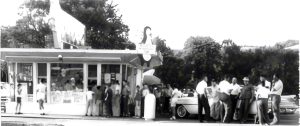
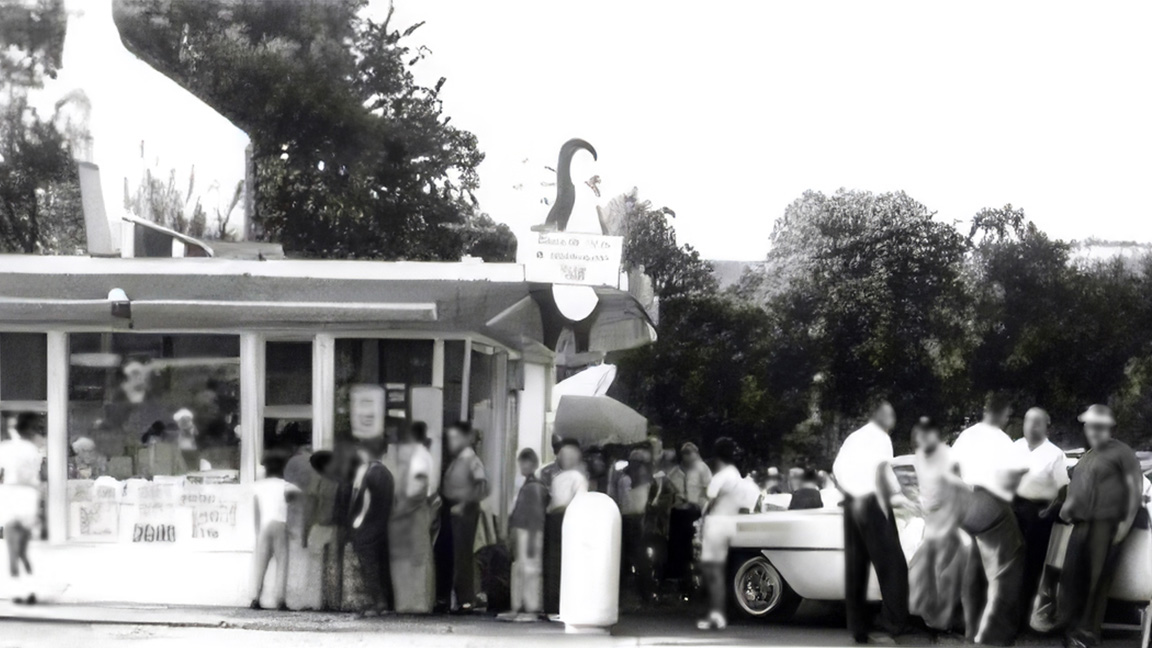
The original Dari Delite in Waynesburg (at the site of the old Pizza Hut)
Ross Drug’s fountain became legendary for two specialties: the Coffee Milkshake (widely regarded as the best for miles around) and their Part Milk Soda – a unique fountain drink remembered by generations of residents. When the store closed on January 1, 1986, newspaper stories devoted almost as much attention to the loss of the soda fountain as to the pharmacy itself.
In many ways, the soda fountains were the social media of their day. News spread there before it reached the newspaper, election results were debated over coffee, romances began over chocolate malts, and generations of children learned that a quarter could fix almost any trauma.
An ice cream soda wasn’t just a soft drink. It was a handmade treat: carbonated soda and one or two scoops of vanilla ice cream mixed so it foamed and floated at the top. It was typically made by a “soda jerk” behind the counter, poured into a tall glass, and served with a long spoon.
For those old enough to remember, Wally Cleaver’s “job as a soda jerk” is one of those perfect snapshots of mid-century Americana that Leave It to Beaver used to capture small-town life. A “soda jerk” wasn’t just a funny title. In the 1950s, it was often a first “real job” for teenagers in that era.
By the 1970s, changing consumer habits and the rise of fast-food restaurants had reduced the importance of drug store fountains throughout America. Most soda fountains faded away due to supermarket competition, and changes in pharmacy business models. Fewer downtown “walk-in” customers forced those few who stayed in business to expand retail space.
However, our readers provided us with a list of shared sweet memories in local establishments long gone. Some of those iconic parlors included the legendary Isaly’s, McCrory’s, and G.C. Murphy fountains on High Street in Waynesburg. One reader also remembered Wilson’s Lunch Room (across from the high school or middle school depending on your age).
While drug stores were part of our early ice cream history, Bryan’s Dairy undoubtably stands at the center of Greene County’s frozen story. More than a place to buy ice cream, Bryan’s was a destination. In the mid-20th century, East High Street would back up for blocks on summer nights and Sunday afternoons as families lined up for hand-dipped cones, thick milkshakes, and sundaes made from locally produced dairy.
It was part plant, part shop, and part community gathering space. For many residents, Bryan’s wasn’t just a business. It was the unofficial social hub of Waynesburg in the 1940s, ’50s, and ’60s, where summer evenings were measured in scoops and conversations on the sidewalk.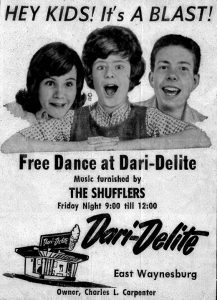
I can remember sitting in front of the store with my grandmother looking at the iconic mounted sail fish in the window. She had taken me there the night of the JFK assassination to distract my young brain from the horrors of that day.
A decade later, the venerable institution continued to thrive despite the fact I landed my first job there scooping ice cream. In college, I remember my buddy’s father swore by the restorative powers of their vanilla milkshake after an overly exuberant night at the Elks.
For a more detailed history of the Dairy, check out our Crossroads feature on the previous page. Although most local restaurants provided sumptuous dessert options, the landscape really changed mid-century.
After World War II, as automobiles reshaped American life, small roadside ice cream stands began appearing across the county. This was the age of the “Dari Delite” or “Dairy Delite” style shop—independent, often family-run, and designed for quick stops rather than long stays. They were simple by design: walk-up windows, neon signage, a handful of picnic tables, and a menu built around soft-serve cones, milkshakes, and sundaes.
The name “Dari Delite” itself was less a brand than a generic description. They were not part of a single chain. They were locally owned businesses borrowing a popular naming style that suggested homemade quality and roadside charm. Some were seasonal, opening only during the warm months.
By the 1950s and 1960s, these stands had become a familiar part of the Greene County landscape. They dotted the roadsides throughout the county. They became gathering places for families and teens, offering a cold break from long workdays and humid summer nights.
The Carpenter family owned the original Dari Delite in Waynesburg (Where the old Pizza Hut now stands in Morrisville). It was a popular teen hang out in the 1960s and 70s. The “cool kids” reigned on the picnic tables under the neon lights. I can remember being sent to run that gauntlet to the window as a small child to retrieve my twist cone and a “banana split without the banana” for my mother. The Delite closed early in 1977, and Pizza Hut was open by early 1980.
The Twin Cup in West Waynesburg at the bottom of Tollgate Run was another such establishment. It offered the iconic chocolate/vanilla twist cones and great milkshakes along with burgers and fries. Much of its business came after the Little League games finished at Emerald Field across the road.
Reader Ann Bargerstock remembers The Custard Stand on Route 88 owned by the Mavins, who also owned the Ice Plant. She also mentioned Hoge’s Dairy Bar on Route 21 near Carmichaels. It had the added attraction of a popular mini-golf course.
Lisa Rumble Miller, who now owns the Ice Plant, remembered Prete’s Twin Twister in Dilliner and Longo’s Confectionary in Greensboro.
Julie Miller recalls a place called Carney’s in Rices Landing (Where Italian Boys is now located)
Several readers remembered Reesman’s Dairy Delight and Brodak’s Ice Cream Shop (in the video store) across the bridge near Fredericktown. My friends and I would often drive all the way to Reesman’s for the outstanding milkshakes. (It had nothing to do with meeting Beth-Center girls)
In the 1970s, the ice cream stand had reached its peak as a cultural fixture. Summer evenings often meant car radios and circling the Delite to survey the social scene. But even as demand remained strong, the foundations of the industry began to shift. National chains introduced inexpensive soft-serve desserts, and dairy consolidation changed the economics of small-scale production. One by one, many of Greene County’s independent stands began to close or transform into other businesses.
One establishment that successfully bucked the trend was Scott’s Delite on Washington Street near the college. The Scott family had bought the business from the Carpenters in 1977 and moved it across town to the bottom of campus. The building had been a pizza shop owned by Gary Klinefelter. They kept the original Dari Delite name for the first three years before changing it.
The place was jammed every summer night with basketball campers and year-round by college students and locals ordering the Every-Day Special. But it is best remembered for their incredible milkshakes. Alicia Harry recalls repeatedly sending her husband to Scott’s during her pregnancy to satisfy her craving for their special butterscotch shakes. Scott’s lasted until 2000, proving an exception to the national trend.
The decline continued through the 1980s and into the early 1990s. Former ice cream stands became pizza shops, retail spaces, or vacant roadside buildings. Some simply disappeared without formal closure notices, remembered only through old photographs or yearbook advertisements. The “Dari Delite” era, once so visible on summer nights, faded gradually rather than ending abruptly.
However, there were fitful attempts to rekindle the magic of the previous era. Reader Becky Milliken Yeager reminded us of places such as Uncle Sam’s (Where the old Rite Aid in Waynesburg stands). They also had a good old-fashioned miniature golf course.
Those in the western end of the county remember Burns Delite in Wind Ridge – a mandatory stop when leaving Ryerson.
Lori’s Dip and Twist (at the current site of the American Judo Hapkido Institute) was a wonderful throwback to the halcyon days of traditional ice cream parlors.
Today’s Contenders
Yet the tradition never fully vanished. In the area, there are still places that are writing their own chapters of local ice cream history. These are unique, small-town stops where sweets, nostalgia, and community overlap.
Fortunately, Waynesburg has 5 Kidz Kandy, RGB Coffee, and the new Burgers and More Ice Cream. To the west, South Fork offers Rogersville tasty options. The newly opened Lilliana’s Sweet Shop is a delight in Mount Morris. A short drive east and one can experience a host of wonderful stops such as LK Café near Carmichaels, Route 21 Ice Cream in McClellandtown, Jackson Farms Dairy in New Salem, and Mountaineer Guns and Ice Cream in Morgantown. They all offer fantastic frozen treats as part of their menu.
With luck, these places will add to our ice cream history, creating another delicious layer for future generations. They represent the quiet transformation of a rural county adapting to changing times while holding onto the taste of summers past.
In the end, Greene County’s ice cream story is not about what was lost, but what was shared – a scoop of vanilla on a hot night and a tradition that still melts into local memory.