

Musky fishing with friends is about much more than trying to catch one of the most elusive freshwater fish. It is an adventure that combines patience, teamwork, and unforgettable memories on the water. Whether trolling along the banks of the Monongahela River at sunset or spending long hours casting along weed beds and rocky points, the experience is made richer by the company of good friends.
The muskellunge, often called the “fish of ten thousand casts,” is a reference to their elusive nature and the patience required to catch one. It has earned its reputation as one of the most challenging game fish to catch and success requires persistence, skill, and a willingness to keep trying even when the fish refuse to bite.
Craig Brewer, a long-time friend and fishing companion, is one of the best when it comes to chasing and catching these predators. After seeing several successful pictures of catches on social media, I said to him “I need to get on that boat with you”. When my opportunity came, I was eager to accept and with great anticipation we were off to the river.
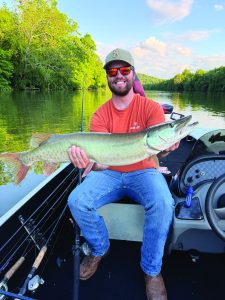
Zach Wilson with his river monster
Completely uneducated in the “way of the muskie”, I really didn’t know what to expect. We were using lures bigger than most of the trout that I have been landing recently. The poles were slightly more flexible than a broom stick, and you could drag a tractor in with the reels. When I picked one up for the first time…“you’ll see why” was all he said.
Trolling is the preferred method of fishing for these giants in June and July. Drifting slowly along the shoreline and covering as much territory as you can. Later in the summer, when the weed beds have developed, casting into them is the preferred tactic. Craig knows the Monongahela River like you know your kitchen. He fishes for muskie three or four times a week.
Muskies are ambush predators that swiftly bite their prey and then swallow it head first. Muskies are the top predator in any body of water where they live, and they will eat larger prey than most other freshwater fish would consider. Their diet consists of many other fish, muskrats, mice, frogs and ducks. They are capable of eating prey up to two-thirds of their body length due to their large stomachs.
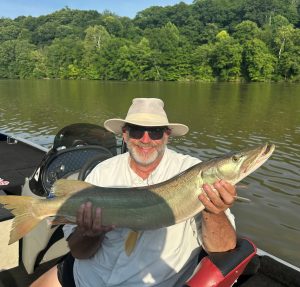
T.R. Mahle with a nice catch!
Once on the river, teamwork becomes essential. With four poles in the water, my job was to drive the boat, scan the river for floating objects, and monitor the depth finder to keep us at approximately 13-16 feet of water. Craig, perched in the front seat, selected which lures to use, and guided me in-and-out of his favorite areas to fish. Bright bucktails, large crankbaits, and topwater lures all have their place depending on the weather and water conditions. I was taking in everything I could to help improve my fishing skills.
It was very peaceful trolling along the banks of the river as the scenery was quite impressive. I enjoyed getting a different view of the Morgantown waterfront locations that until then I had only seen from the roadways.
My quiet floating trip was about to take a drastic turn. One second our lures are gliding through the water, and the next, a violent explosion erupted as the fish ferociously attacked our lure. The rod was bending deeply and the reel was screaming as line peeled away. As adrenaline took over, I grabbed the pole and hung on for dear life. “Reel faster,” Craig instructed as he frantically tried to reel in the other three poles.
This Muskie fought with incredible strength and raw power, it was making long runs, powerful head shakes, and one spectacular leap that truly tested my limited skill. It took focus, patience, and quick reactions on my part to keep a fish of this size securely hooked.
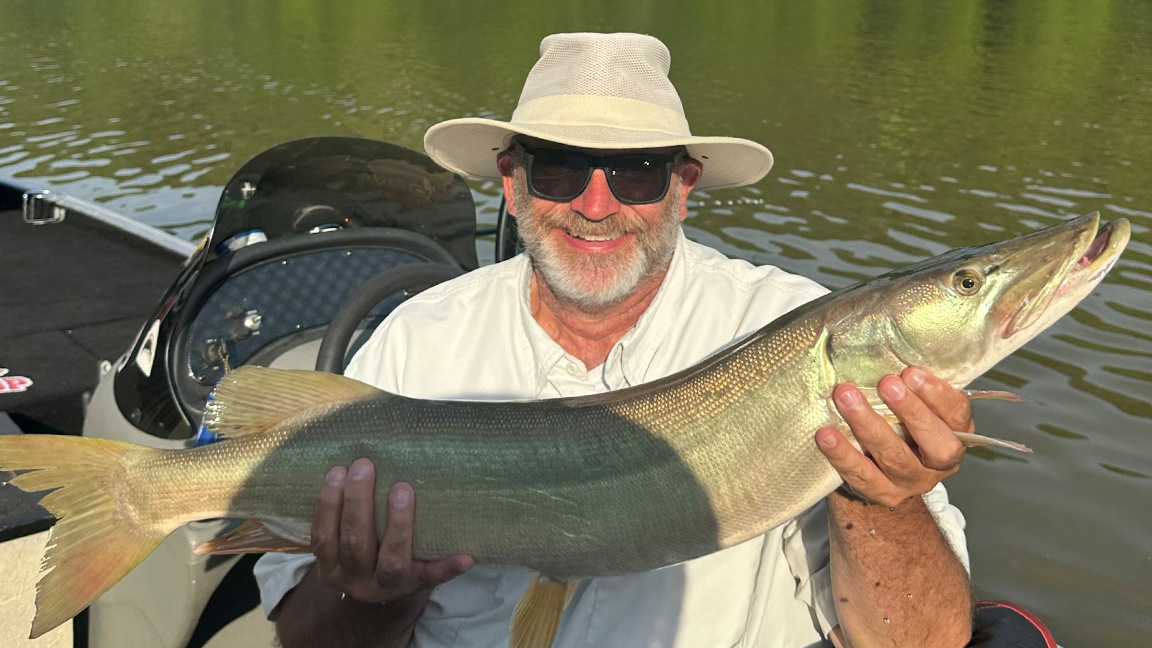
As my battle with this monster continued, my anticipation was building until I finally brought the muskie alongside the boat and Craig expertly netted him. Seeing its massive body and sharp teeth up close was both thrilling and humbling. Successfully hooking a muskie is more than catching a fish—it is an experience that leaves a lasting memory.
The hooks were carefully removed, he handed me the fish, and we took a quick photograph before releasing it back into the water. Catch-and-release practices help protect muskie populations so future anglers can enjoy the same thrilling experience. Watching a healthy fish swim away is often just as satisfying as catching it.
I was very lucky to hook into a muskie on my very first time out. Not every trip ends with a trophy fish, but that rarely matters. The time I spent with my friend on the water and the conversations we had during the down time will become some of my best memories. We saw lots of wildlife and a beautiful sunset…I keep reminding myself that fishing is about appreciating the outdoors as much as catching fish.
Over time, I hope to make a few more trips with my buddy to the river…strengthening friendships through shared experiences. In the end, musky fishing with friends is not simply about landing a fish. It is about spending quality time together and creating memories that last a lifetime. The thrill of the catch, the beauty of nature, and the companionship of trusted friends will make every future musky fishing trip an adventure worth repeating, regardless of the number of fish caught.