

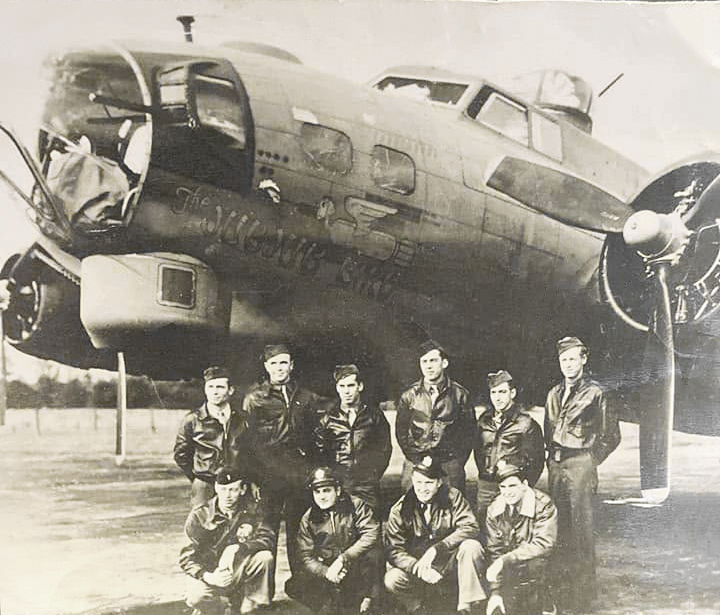
For Roger Lemley, it started with a photograph. As a young boy, he became fascinated by an 8 X 10 glossy in his father’s gun cabinet. In the photo was his cousin, Hershel “Ted” Bowers and the crew of his B-17 bomber during World War II. Like many boys of his era, Ted had enlisted soon after graduating from Mt. Morris High School.
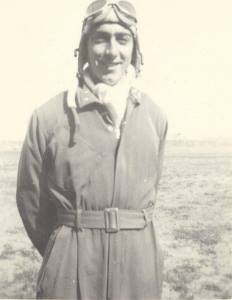
Herschel Wayne “Ted” Bowers T SGT 401 Bomb SQ 91 Bomb GP (H) Born 10-20-1918 Died 11-02-1944
There was something about the photograph—and the story behind the young man staring back from it—that stayed with Roger. That B-17 “Flying Fortress” was one of the heavy bombers that carried the war into the skies over Nazi Germany. On November 2, 1944, Ted and his crewmates were assigned to a bombing mission to hit an oil refinery near Merseburg, Germany.
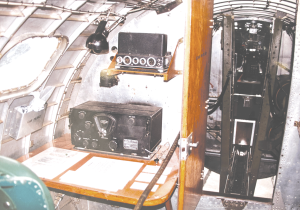
Radio Operator’s Area B-17 Bomber. While not Ted Bower’s exact workstation, he would have worked in one like this in WWII.
They completed their bombing run and released their load. But before they could escape the area, the aircraft was struck by three bursts of German anti-aircraft flak. The damage was catastrophic. The nose of the aircraft was blown away, and bombardier Jim Hundley and navigator Dan De Bonis were struck. However, co-pilot Ray Nickola and waist gunner Arnold Kramer managed to parachute from the crippled aircraft. Both survived and were eventually taken prisoner.
However, the remaining four members of the crew crashed near the small German village of Priester. In addition to Ted, Jim Foltz, Carrol Tallant, Luther Salter, and Herb Chouinard were killed. They were hastily buried in a small church yard in that village.
After the war, the bodies of the men were exhumed and buried where their families had requested. Ted was eventually laid to rest in the American Cemetery in Luxemburg. For most families, the story might have ended there—or at least remained frozen in the incomplete information contained in military records. His family knew where he had been and when he had been killed, but the details of those final moments were lost somewhere across the Atlantic.
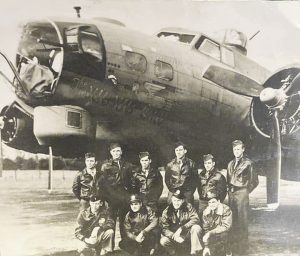
Crew of the Jub Jub Bird Flying Fortress
(front row from left) Herb Choulnard, pilot; Dan DeBonis, bombardier; James Hundley, navigator; and Ray Nicola, co-pilot; (back row) Luther Salter, engineer; Arnold Kramer, waist gunner; James Foltz, ball turret gunner; Leon Wagner, waist gunner; Herschel W. Bowers, radio/gunner; and Carroll Tallant, tail gunner.
However, Roger was still haunted by the need to complete the story of his cousin. The photograph that had captured his attention as a boy had become something more than an old family picture. It represented a person whose story deserved to be told. In 2005, Roger began trying to reconstruct the full story via the internet. He searched for records, followed leads and worked to identify people who might have remembered the crash. He connected with a German citizen named Peter Gajda who helped research the crash and its aftermath.
Eventually, that effort led to a remarkable discovery. Peter found a witness named Helmet Rosche, who knew the story of the aircraft and the fate of the men aboard it. He had witnessed the event as a 16-year-old boy. Suddenly, the photograph from Roger’s childhood had a connection to real people and a story that had survived the passage of decades.
Rosche’s knowledge helped fill in pieces that had been missing for generations. Roger could finally begin to understand what had happened to Ted and his fellow crewmen after their aircraft crashed near Priester. Rosche recalled how the mayor of the town asked a German officer what to do with the bodies. The officer replied, “just bury the criminals somewhere.” British and French prisoners of war were forced to dig the graves. The mayor had tried to make the burial as “dignified” as possible and wrapped the bodies in tent awnings.
But Roger wasn’t content simply to know the story. He wanted the men remembered where they had fallen. Through his efforts, arrangements were eventually made for a ceremony on November 3, 2019, in the same tiny chapel where the men had initially been buried. A plaque was placed there in their honor, providing a permanent reminder of the young Americans whose lives ended far from home protecting the world from authoritarian dictators. Even the American consulate in Germany attended the ceremony.
For Roger, it was the completion of a journey that had begun decades earlier with a photograph. There is something remarkable about the way family stories can work. Sometimes they begin with just a name. Sometimes it is a faded letter, a uniform tucked away in a trunk or a photograph of someone who died before the next generation was old enough to know them. For Roger Lemley, it was that photograph of his cousin Ted.
As a boy, he could not have known where the picture would eventually lead him. He could not have imagined tracing the final flight of a B-17 across Germany, searching for witnesses and working to establish a memorial thousands of miles from home. But he kept looking. And because he did, Greene County’s Ted Bowers and the other members of his crew have a story that reaches beyond a military record or a date on a memorial.