

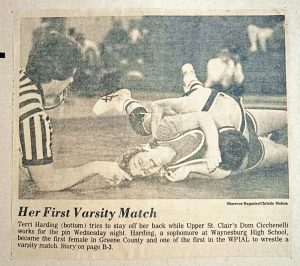
When Terri Harding walked onto the wrestling mat for Waynesburg Central High School during the 1985-86 season, she wasn’t simply preparing for another match. She was stepping into history.
At a time when girls competing in varsity wrestling against boys was unheard of, Harding became one of the first female wrestlers in the country to compete in a boys’ varsity match. There were no girls’ teams and no roadmap for young women who wanted to wrestle. She entered a sport dominated exclusively by boys, relying on determination, and a willingness to challenge long-held traditions.
Many spectators likely viewed the moment as an oddity. Few could have imagined that four decades later, girls wrestling would become one of the fastest-growing high school sports in America, complete with sanctioned championships and college scholarships.
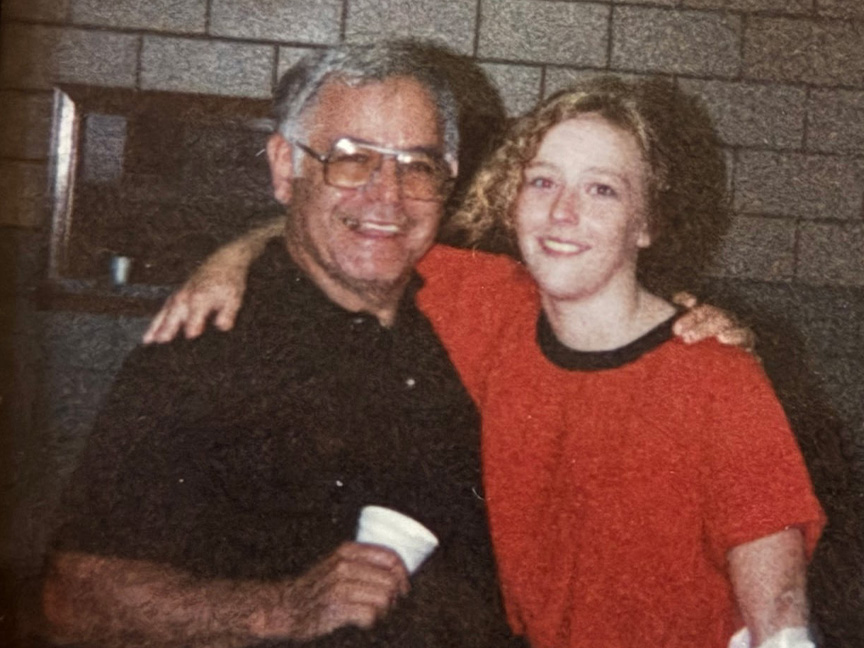
Harding with Coach Joe Ayersman shortly after her post-graduation surgery
Harding decided she wanted to wrestle starting in middle school. She remembers telling gym teacher/wrestling coach, Terry Cole, toward the end of school that she wanted to go out for the team the following year. “He was fine with it. No negative reaction at all,” she recalls.
By the following year, Ron Headlee had taken over the junior high program. The future PA Hall of Fame coach was very supportive and accepted her as part of the team. “He was really great and helped me a lot.” The following year, her luck with coaches continued as she entered another Hall of Fame coach’s program – Joe Ayersman.
Harding shared her admiration for Coach Joe, “I am so glad my experience with wrestling was under his guidance because elsewhere it would have been vastly different.”
The admiration is mutual. According to Ayersman, “She never asked for anything special. She did everything the boys did without a word of complaint. I never heard the boys say anything negative. They accepted her because she took the sport seriously and worked hard.”
She wrestled for two seasons in junior high. Then, her sophomore year, she stepped onto the varsity mat and into the history books after winning her elimination match. Her opponent was Dom Ciccenelli of Upper St. Clair.
For generations, communities like Waynesburg have celebrated wrestling with the same passion reserved elsewhere for football and basketball. Yet until recently, girls who wanted to wrestle often had only one option—join the boys’ team.
However, in 2023, the Pennsylvania Interscholastic Athletic Association (PIAA) officially sanctioned girls wrestling, making it a recognized championship sport after years of rapid participation growth and grassroots advocacy. The decision marked a historic milestone and opened the door under the PIAA banner.
Participation has climbed by more than 200 percent in recent years, with girls now competing in every one of the state’s PIAA districts. Youth wrestling programs are seeing increasing numbers of girls entering the sport, creating a pipeline that promises continued growth.
Women’s collegiate wrestling has also exploded nationwide as universities recognize growing interest. More than 100 colleges now sponsor women’s wrestling. Waynesburg University has also invested in women’s wrestling. Beginning this year, its program will compete for a Presidents’ Athletic Conference championship.
The growth has also changed public perception. Fans who attend girls’ tournaments quickly discover that the intensity and excitement mirror what has made Pennsylvania wrestling famous for generations. Communities have embraced the change as well. Parents, coaches, and former wrestlers who once viewed girls wrestling as unusual now often become its biggest advocates.
No doubt, this legacy belongs to athletes like Terri Harding. When she wrestled in the 1980s, she had no female role models. There were no girls’ state championships to pursue. Success required extraordinary courage because every match carried the weight of challenging expectations.
Today’s young wrestlers benefit from those early pioneers. They can dream of district titles, PIAA championships, collegiate careers, and perhaps even representing the United States on the international stage.
Incredibly, Harding’s accomplishments would reach beyond the mat and border on the surreal.
After her freshman year of college, she became critically ill with meningococcal meningitis. The disease forced surgeons to amputate both legs below the knee, her left arm below the elbow, her right thumb, and portions of the fingers on her remaining hand to save her life. She endured months of surgeries, rehabilitation, and physical therapy.
Rather than allowing the tragedy to define her, Harding became an inspiration throughout Pennsylvania. She learned to walk with prosthetic legs, drive a car, dance, and live independently. Her positive outlook attracted national attention, and her story was featured in newspapers across the country.
One of the most memorable chapters in her recovery came through the Miss Rain Day Scholarship Pageant in Waynesburg. Competing just a few years later, Harding took the stage and performed a dance routine using her prosthetic legs. Her performance earned the pageant’s Talent Award, drawing standing ovations and emotional reactions from the audience.
Today, Terri Harding’s legacy extends beyond wrestling or pageantry. Her journey reminds us that life’s greatest victories are often won long after the final whistle blows or the medals have been awarded.

Accompanied by her son Drake, Harding visited her mentor last month
Looking back, her varsity appearance wasn’t merely a local curiosity. It was an early glimpse of a future that has finally arrived—a future where girls wrestling is no longer a novelty, but an established and thriving part of Pennsylvania’s rich wrestling tradition.