

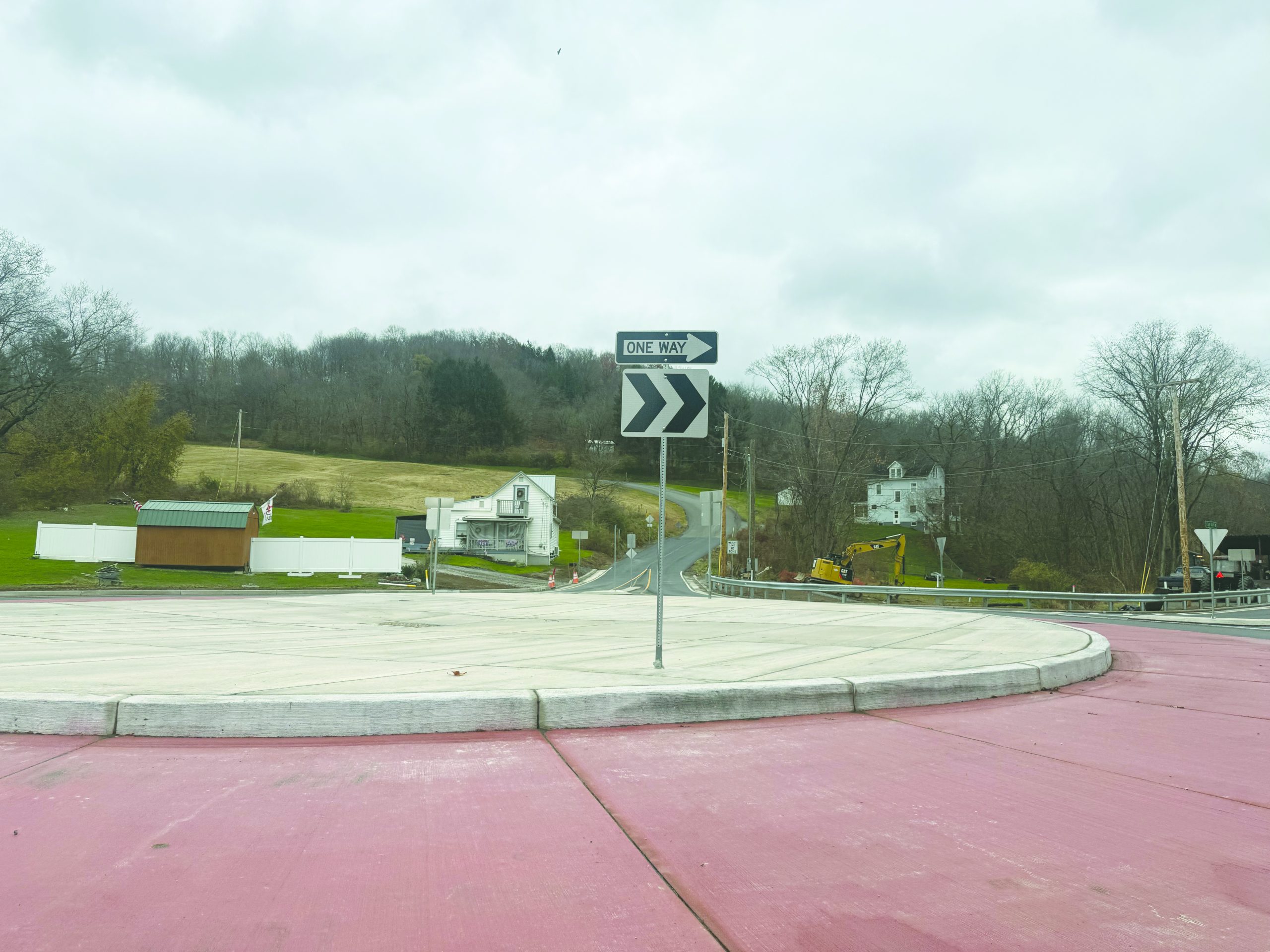
Sugar Run Road Intersection
There was a time when approaching an intersection meant making a fairly simple decision: stop, look both ways and proceed when the road was clear. These days, motorists around here are being asked to reconsider that familiar routine and, quite literally, go around in circles.
I have talked to several individuals who completely avoid the new Morgantown exit because of their anxiety about the circular chaos that awaits them.
Likewise, the ongoing roundabout improvements near Waynesburg’s Sugar Run have generated questions and controversy among motorists who aren’t necessarily convinced that a circular intersection is an improvement over the traditional crossroads. For some, the idea of surrendering the familiar stop sign or traffic signal in favor of a continuous loop of moving vehicles is a little unsettling. Others see it as a sensible solution to safety concerns.
And, as with most changes involving local roads, there is no shortage of opinions from people who travel them every day.
The Sugar Run Road project in Franklin Township is a good example of the changing approach to local transportation. PennDOT’s plans call for a single-lane roundabout where Sugar Run Road, Porter Street and Orchard Road meet. Planning and public outreach began a decade ago, and construction is scheduled to extend into 2027.
The roundabout concept itself has a much longer history than most people realize. America’s earliest circular traffic intersection was Columbus Circle in New York City, designed by traffic engineer William Eno and opened in 1905. Early traffic circles, however, had a significant flaw: entering motorists often had the right of way, which contributed to congestion and accidents.
The modern roundabout took shape in Great Britain during the 1960s. In 1966, the British adopted a rule requiring entering vehicles to yield to traffic already circulating. That simple change helped transform the design into the more efficient intersection familiar today.
The terminology has traveled almost as much as the traffic itself. In New England, particularly Massachusetts, motorists commonly refer to them as rotaries. I remember being particularly intimidated by them when I moved there right out of college in the early 80s. In other parts of the country, they are called traffic circles, although roundabout has become the preferred engineering term.
Greene County actually has a little history with circular intersections of its own. In downtown Carmichaels, the historic town square known as The Diamond has served as the community’s focal point since its founding. The square was central to the original town plan, although its age should not be confused with the construction date of the present traffic arrangement.

Today, roundabouts are becoming increasingly common because they can reduce the number of potential collision points, slow approaching traffic and eliminate the need for some traffic signals (which are incredibly expensive). They are particularly effective at reducing the likelihood of severe right-angle and head-on crashes.
Of course, statistics and engineering diagrams don’t necessarily make a motorist feel more comfortable when approaching something unfamiliar. There is a learning curve, and the first trip through a new roundabout can produce a moment of uncertainty. Some drivers worry about choosing the correct exit, while others simply wonder why a perfectly good intersection needed to become a merry-go-round.
Eventually, however, familiarity tends to replace apprehension. Drivers learn to slow down, yield to circulating traffic, signal when appropriate and follow the signs.
Whether you call it a rotary, traffic circle or roundabout, the objective remains the same: getting everyone where they are going with a little less stopping, a little less waiting and, hopefully, fewer collisions.
The Roundabout Survival Guide
1. Slow down as you approach. (Watch for pedestrians and cyclists)
2. Choose the correct lane before entering if it is a multi-lane roundabout. Signs and pavement arrows usually tell you which lane to use.
3. Yield to traffic already in the roundabout. In the U.S., that means yielding to vehicles coming from your left.
4. Enter when there is a safe gap. (No need to stop if the roundabout is clear.)
5. Travel counterclockwise around the center island.
6. Stay in your lane.
7. Do not stop inside the roundabout to let another vehicle enter.
8. Use your right turn signal as you approach your exit.
9. Yield to pedestrians in the crosswalk when exiting.
Use the right lane for the first exit or straight ahead, and the left lane for straight ahead or going three-quarters around. (But always follow the posted signs)
One important point: if you miss your exit, do not stop or make a sudden lane change. Continue around the roundabout again and take the exit safely the next time