


For generations, the holiday season in small-town America was defined by the glow of downtown lights, the crunch of snow beneath boots, and the familiar ring of a shopkeeper’s bell as customers stepped through the door. Shopping for Christmas wasn’t just about buying gifts. It was about connection.
In Waynesburg, families strolled block by block through mom-and-pop stores like Doody’s Jewelers, Carol Lee’s Dress Shop, Meighen’s Shoes, Heasley’s Men’s Store, Betsy Ross Gift Shop, and Levine’s Furniture. They chatted with merchants they knew by name, often paying for purchases on store credit or layaway. The experience was personal, local, and deeply woven into the fabric of the community.
But over the past seventy-five years, that ritual has undergone a transformation as sweeping as any cultural shift in American life. From the family-owned hardware and clothing stores of the mid-twentieth century to the rise of regional shopping centers, the dominance of big-box retailers, and finally the digital reign of Amazon, each stage of this evolution has reshaped how and where rural Americans spend their holiday dollars.
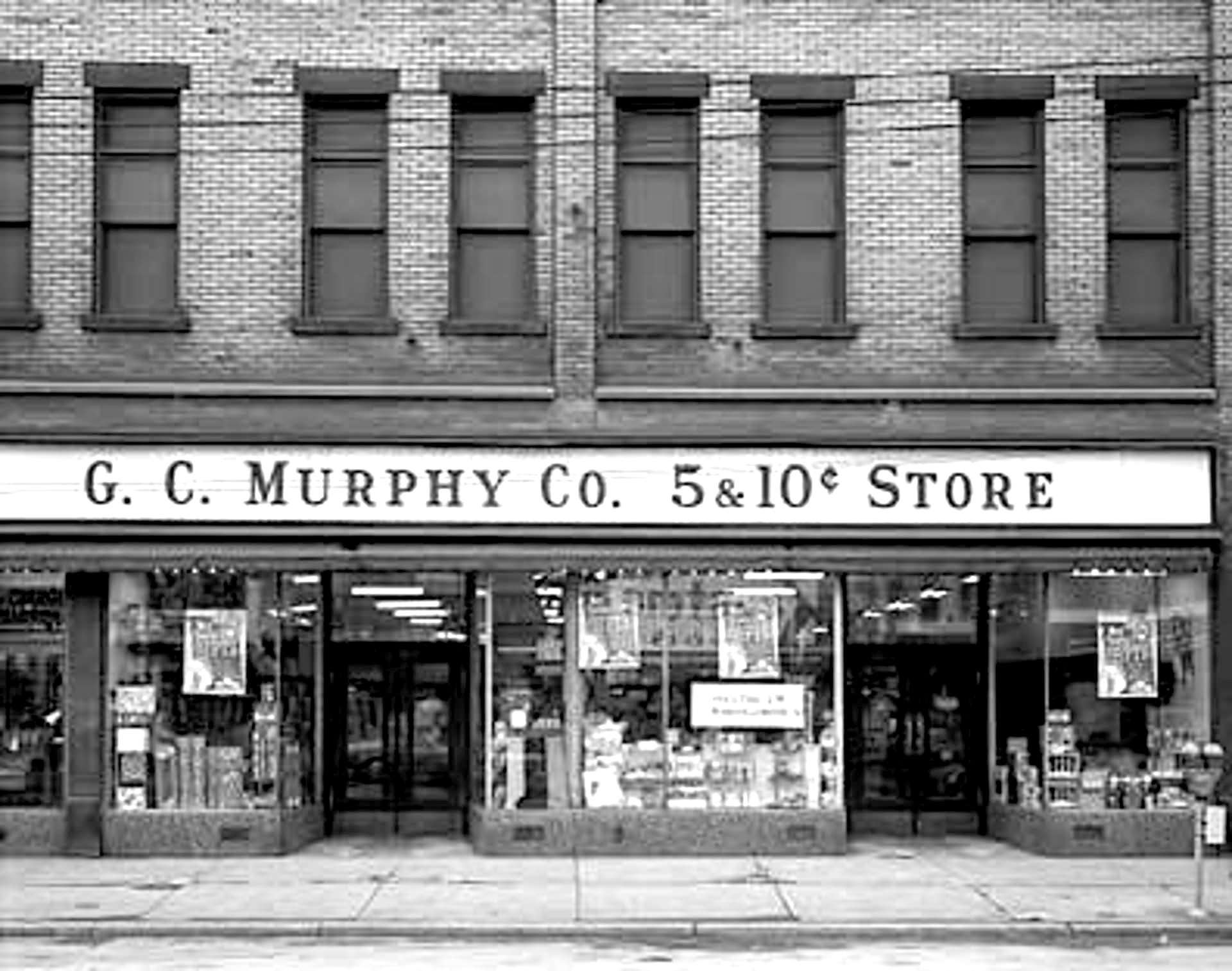
In the 1950s, Main Street served as both an economic and social hub. Businesses like G.C. Murphy’s Five-and-Dime, McCrory’s, Roth’s Army & Navy, and Long & Co. Department Store weren’t just places to buy gifts – they were the backbone of our commercial existence. Merchants like Ross Drug, Ullom & Baily and The Fashion Shop sponsored Little League teams, hung garland across the streetlights, and stayed open late on December evenings so families could shop after games or school concerts.
Credit was personal. The owner might jot your purchases in a ledger, knowing you’d pay after the first of the year. Kids visited Santa in the basement of Murphy’s on the way to the toy department. The atmosphere was one of anticipation and community, and every dollar spent circulated back into the same small-town economy that sustained local families.
But by the late 1960s, the first tremors of change began to ripple through that traditional model. Many of us are old enough to remember Western Auto stores. For those of you who aren’t, it was a precursor to Walmart, albeit on a much smaller scale. It was indeed an auto store, but it also sold toys, appliances, sporting goods, firearms, bicycles, and musical instruments.
In 1968, the H-P Department Store had its grand opening three weeks before Christmas in the Long Building across from the police station. Their ad claimed, “Joy begins with one of our exciting dresses from our fabulous holiday collection.” (The dress prices were listed between $7.95 – $10.95)
Unfortunately, the store’s run was short-lived. By the end of that decade, more families were starting to have two cars in the garage and Interstate 79 opened to Washington. Suddenly, people were willing to drive farther for more choices and cheaper prices.
In the 1970s, the shopping experience shifted toward regional business centers. Shoppers increasingly made weekend trips to Washington and South Hills, where the enclosed malls promised variety, comfort, and convenience. I can remember the anticipation of such trips when my mother would pile us in the back of our ‘68 Ford Country Squire station wagon in my search for a prized G.I. Joe to rescue from his retail stalag.
Stores like JCPenney, Sears, and Montgomery Ward provided a sense of modernity and efficiency that Main Street shops often couldn’t match. Unfortunately, the appeal was simple: everything was under one roof, protected from the weather, with extended hours and consistent prices. Small-town businesses fought to keep up, but the gravitational pull of the mall proved hard to resist.
By the 1990s, many rural downtowns had emptied out, leaving behind vacant storefronts or niche shops catering to a shrinking clientele. Western Auto stores were bought up by Sears, and their remaining assets became Advanced Autos. G.C. Murphy was bought out by Ames Department Stores, who headed to the strip malls outside of town.
Then came the big-box era. It was a retail tsunami that swept across rural America in the 1990s and early 2000s. Walmart, Target, Lowe’s, and Home Depot didn’t just compete with local stores; they replaced entire sectors of them. One stop could cover everything from groceries to toys to electronics. Prices were lower, inventory was vast, and hours were convenient.
For families on tight budgets, especially in working-class rural communities, these stores were a financial lifeline. But the cost to local economies was steep. Independent clothing shops, toy stores, and grocers couldn’t match the buying power of multinational chains.
Main Streets across rural America dimmed even further. Storefronts that once buzzed with holiday cheer turned dark, while the glow of a big-box sign on the highway became the new beacon of the season. Parking lots replaced sidewalks as the stage for the annual shopping rush.
Although in some ways, there was still a sense of shared experience. Love it or hate it, Black Friday became an event. People lined up before dawn, bundled in winter coats, swapping coffee and stories while waiting for the store to open. At least, shopping remained physical and tangible even if it had moved a few miles down the road.
Then, almost overnight, the ground shifted again. When Amazon launched its Prime service offering fast shipping, it began rewriting the rules of holiday shopping. At first, online shopping seemed like a novelty. But as broadband expanded and smartphones became ubiquitous, the digital checkout line replaced the physical one. Instead of braving crowds, rural shoppers clicked “Add to Cart” from their living rooms.
The pandemic accelerated that shift dramatically. Lockdowns, supply chain disruptions, and health concerns pushed even the most traditional shoppers online. Amazon, already dominant, became nearly essential.
Today, the holiday rush looks very different. Delivery vans rumble down our roads, and porch pirates are more of a concern than crowded aisles. The convenience is undeniable. There’s no driving, no crowds, no closing hours. But something intangible has been lost.
The economic effects are complicated. On one hand, online retail has given rural Americans access to goods once unavailable locally and created delivery and logistics jobs. On the other hand, the money leaving small communities for national corporations never returns in any significant manner. Local tax bases have shrunk, and with them, the budgets for public services and community events.
Some small-town retailers have adapted, blending old-fashioned service with new technology. Some shops and boutiques throughout the county now maintain social media pages, offer online ordering, and promote “Small Business Saturdays” to remind customers of the human side of commerce.
Farmers markets, craft fairs, and holiday pop-ups have also seen a resurgence, serving as a nostalgic antidote to the facelessness of e-commerce. They may not reverse the tide, but they restore a sense of connection. They are undoubtably proof that many Americans still crave a shopping experience rooted in place and community.
Ultimately, the transition from mom-and-pop stores to Amazon reflects more than just changing retail models. It mirrors broader cultural shifts toward efficiency, scale, and isolation. The old Main Street Christmas was built on relationships and the sense that your purchases mattered to someone you knew.
Now, our holiday shopping is mediated through algorithms and warehouses, optimized for speed but stripped of intimacy. The ritual remains. We still buy, give, and celebrate, but the experience has become more solitary.
And yet, glimmers of our past remain. Local organizers in several towns around the county are creating events to capture the zeitgeist of those traditional community holiday experiences. Fortunately, we still have those who hang festive lights, hold parades, and welcome shoppers who value the warmth of human exchange over the click of a mouse.
The story of holiday shopping in rural America isn’t over—it’s simply evolving. The question for the next generation is whether convenience will continue to outweigh community, or if the pendulum might someday swing back toward the personal, the local, and the beautifully imperfect.
Robert Frost once said, “I can sum up everything I’ve learned about time in three words: it goes on. Yet, we can still mourn inwardly, even as we accept that time and technology have forever altered the charm of Main Street at Christmastime.