

From the earliest days of the American colonies, the nation has had a complicated relationship with alcohol. The colonists drank beer, cider, wine and spirits as part of everyday life. Alcohol was considered a wholesome, practical and accepted part of community life.
George Washington produced both whiskey and brandy on his Mount Vernon Estate. He extolled the virtues of alcohol and said it was important for the morale and fighting spirit of his men. John Adams and Thomas Jefferson were both firmly in the same camp.
However, Washington’s right-hand man, Alexander Hamilton was vehemently opposed to any alcohol because of the trauma it had inflicted on his family as a youth. His contempt for liquor (and the common man) was instrumental in his influencing Washington’s disproportionate overreaction to the Whiskey rebellion.
In addition, the Second and Third Great Awakenings of the 19th century brought religious and political overtones into the debate.
That tension between alcohol as a social custom or a social problem has never entirely disappeared. From colonial taverns to modern-day bars, America has continued to debate where enjoyment ends and excess begins.
Long before Greene County had restaurants and social clubs, it had taverns. In the earliest days of settlement, a tavern was much more than a place to get a drink. It was an inn, restaurant, post office, and community center rolled into one. Travelers needed somewhere to eat and sleep, and the tavern became one of the first established businesses in a developing community.
Greene County’s location along the Mon River and the roads connecting southwestern Pennsylvania with Virginia made taverns a natural part of early life. The Rices Landing area became an important stopping point for travelers arriving by river.
Although the name sounds like a contradiction, “Dry Tavern” once had a very literal meaning. The tavern in the area served travelers but did not sell alcoholic beverages. Travelers knew they could obtain food and lodging there—but not a drink.
During the 19th century, drinking establishments were common throughout Pennsylvania, particularly in rural communities where locally produced whiskey was an important commodity.
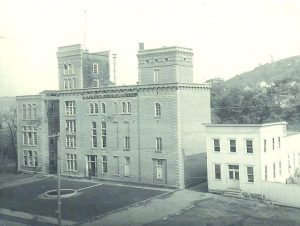
The Waynesburg Brewery on Southside near the bridge lasted from 1902 until 1909 when the temperance movement forced its closing.
The new nation had imposed heavy tariffs on molasses from the Caribbean, which limited the supply of rum. The Scots-Irish farmers of western Pennsylvania were more than happy to call on their “spirited” history to profit from the excess corn and rye on their farms. Afterall, “a horse that could carry four bushels of grain could carry the whiskey made from 24 bushels of grain”.
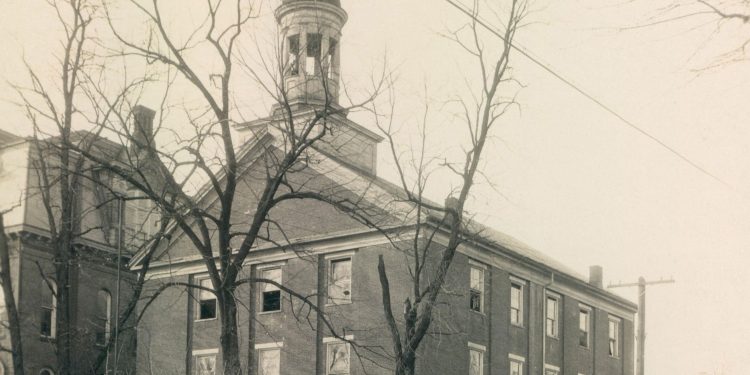
One of the earliest establishments was the Bull’s Head Tavern in Waynesburg, erected in 1803. It gave way to the Downey House, which was built in 1869. After it was destroyed by fire in 1925, the Fort Jackson Hotel was erected on the same spot. Another early establishment in Waynesburg was called Hoskinson Tavern, which stood on Sayers Corner.
The first court cases in the county were held in 1796 at Jacob Cline’s Muddy Creek Tavern. In addition, Francis Seaton’s Tavern in Carmichaels/Old Town operated alongside his store and mill on Muddy Creek.
There was also a well-known 19th century establishment called the Red Tavern in Carmichaels. It was on the corner of West George and Market Streets. Historical accounts describe it as a popular gathering place.
By 1870, Fredericktown had both a distillery and two hotels. Interestingly, Frederick Wise, who laid out Fredericktown in 1790, agreed in 1793 that no distillery would be erected on the town plot. Nevertheless, distilling eventually became an important local industry.
The Burson & Boyd Distillery and later the Vandegrift Distillery were significant whiskey producers. The Vandegrift operation continued into the early 20th century and apparently survived until around 1920, with the physical facility destroyed by fire in 1925.
But Greene County was also strongly influenced by churches and the growing temperance movement. As communities grew, so did opposition to public drinking and the problems associated with excessive alcohol consumption.
The last saloons and taverns in the county were closed in 1879. However, whiskey was still being sold, albeit illegally, in drug stores for medicinal purposes. No doubt, many individuals manufactured a variety of maladies to circumvent the law.
By the late 19th century, the struggle between the “wets” and “drys” had become a major political and social issue. An article in the Waynesburg Republican in January of 1886 told of a “gambling den” in Waynesburg. In this establishment, there was “drinking, games of chance, hideous load talk, and blasphemous language.”
After calling for appropriate law enforcement in numerous articles, the editor was able to report that justice had finally been served. One of “the ring-leaders” was arrested and given a choice of a $10 fine or 30 days in jail. (He took the 30 days).
Two other men from Jefferson were fined $5 for what must have been the county’s first DUI. They were headed home when they drove their horse and buggy into a trench being dug by the water company. The mistress of the establishment was also fined $5 and was forced to sell her pig to cover the cost.
That same year, a group of women opened a reading room in the Hook Building. The Republican lauded their efforts to provide a wholesome and productive activity for all the men “who loaf about in restaurants and barbershops.” However, according to the story the women’s efforts were “met with small encouragement.”
From 1879 to 1906, every attempt to open a licensed retail outlet that served alcohol was denied by Common Pleas judges who were afraid of political backlash from the temperance forces in the county.
However, there were small distilleries in Dunkard Township, Grays Landing, Bald Hill, and Lippencott. In 1902, the Waynesburg Brewing Company was opened in Franklin Township just across the Ten Mile Creek bridge in Smith Creek.
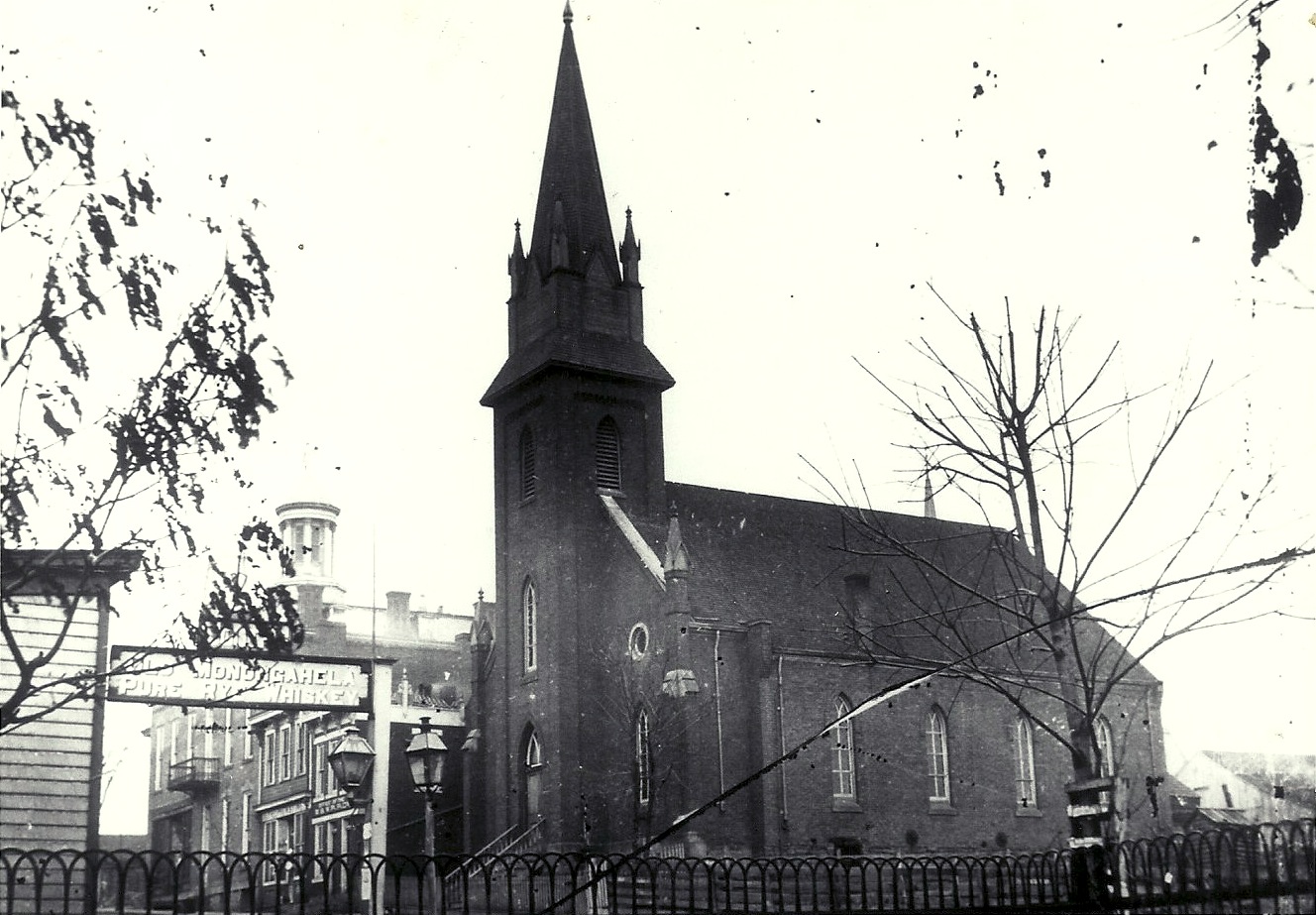
The sign outside a tavern (left) on Waynesburg’s Southside advertises Monongahela Whiskey. The juxtaposition with the Washington Street Methodist Church across the street symbolizes the dichotomy that existed in the county in the early part of the 20th century.
The brewery produced 4,000 barrels of beer a year and provided their product to the German Beneficial, Eagles, and Elks Clubs in Waynesburg and to several small establishments in Rices Landing.
One interesting hearing in Rices Landing at the time took place in front of Judge H.W. Faddis. The Monongahela House (a 19-room hotel) hoped to serve alcohol. The superintendent of Dilworth Coal Company appeared in support of the permit. He asserted the mine was having trouble attracting workers because they preferred to work in nearby Washington and Fayette County mines so they could “unwind” after a hard day or week underground. Despite the economic appeal, the petition was denied.
Two Waynesburg men found a temporary loophole to the dry laws. They opened an “original package store” on N. Washington Street in the 1890s. Federal law allowed the men to sell liquor from West Virginia as long as it was in the original package. However, Congress soon passed a law to remove that exemption.
The Waynesburg Messenger and the Republican had a long running editorial battle during this period with the former in favor of granting liquor licenses. The latter insisted Waynesburg’s economic success and population growth were a direct result of the aggressive temperance movement.
There was a brief lull in the temperance activity in 1906; however, an appearance the following year by national crusader Carrie Nation in Waynesburg and Carmichaels invigorated the movement.
Waynesburg’s temperance movement was particularly powerful. Local women such as Mary Sayers, Mary Parry, Carrie Morris, and Eva K. Bowlby played a prominent role through the Women’s Christian Temperance Union (WCTU). Their activism eventually helped make Greene County the driest county in Pennsylvania.
The battle was fought through Pennsylvania’s local-option system. Rather than simply waiting for national Prohibition, communities could oppose liquor licenses through petitions and formal objections known as remonstrances. The results were striking.
The temperance movement in Greene County was not merely a collection of sermons and resolutions. It was an organized political campaign. The WCTU gathered thousands of signatures, organized opposition rallies to liquor-license applications and encouraged voters to support candidates sympathetic to the temperance cause.
One local saloonkeeper claimed the initials WCTU stood for “Women Come to Torment Us.”
On May 1, 1909, the temperance forces succeeded in closing the Waynesburg Brewery and the remaining distilleries. For the first time in history, Greene County was “completely dry.” (except for the speakeasies, of course)
The county’s commitment to temperance was symbolized in 1911 when the WCTU chapter in Waynesburg placed a bronze drinking fountain in front of the sheriff’s residence. Instead of a tavern offering something to drink, the town was publicly celebrating the availability of water.
In 1914, a new company called Ten Mile Brewing made an application for a state charter to resume brewing in Waynesburg. However, Mary Parry organized a campaign to have all Sunday school children in the county write a letter to the governor to protest the application. She maintained Greene County was the first and only truly “dry county in the state.” The charter application was dropped soon after.
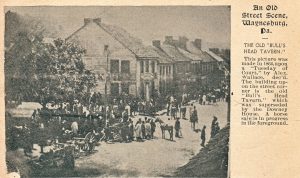
Old Post Card Scene taken in 1864 by Alex Wallace
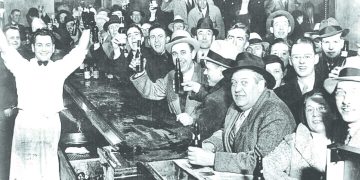
When national Prohibition arrived in 1920, Greene County had already spent decades restricting the sale of alcohol. Of course, there were still stories of bootlegging, homemade liquor and hidden drinking establishments.
When the 18th Amendment was repealed in 1933, Pennsylvania communities were again allowed to determine whether they wanted to permit liquor sales. However, not all Greene County communities answered the question the same way.
Check out “After the Dry Spell,” the Taps Return on page 26 to hear the rest of the story.
Acknowledgements to the additional research of G. Wayne Smith and the assistance of the Cornerstone Genealogical Society staff.