

A century ago, baseball was America’s undisputed national pastime. It was a gritty game played in wool uniforms before roaring crowds packed into brick ballparks.
It was also the undisputed local pastime here in Greene County. Despite all the changes to the game, the heart of baseball remains remarkably familiar. The tension of a full count, the drama of the ninth inning, and the connection between generations brought together by the crack of a bat remain.
I thought it might be interesting to survey the decade of the 1920s from a local baseball perspective.
In the first year of the decade, 19 young men from Jollytown were arrested for playing baseball on a Sunday. They were fined $4 each by Justice John Goodwin. However, the boys obtained the services of attorney James Purman and appealed the case. A “settlement” was reached and the boys did not have to pay the fine. Soon after, the residents of Jollytown became “bitter toward the minister,” and he moved on to another town.
Youth Leagues
In 1927, Judge A.H. Sayers, and local businessmen Joe Doody and Jim Meighen started a Youth Legion team in Waynesburg. By the end of the decade the league expanded to Carmichaels, Nemacolin, Bobtown, Greensboro, and Rices Landing. The winners of the league would play Uniontown at the end of the season.
By the 1930s, there were eight teams in Waynesburg alone: the Druggists, South Penn, Army-Navy, Hardwares, Schreiber’s, Star Candy, Inghram’s, and Kennedy’s.
High Schools
Although baseball was not yet a sanctioned WPIAL sport, several local high schools had teams. Nineveh was the local powerhouse and was the first team in the area to wear real uniforms (or “baseball suits” as they were called at the time). Jim Johnson and Jake Porter were the team’s best players.
Waynesburg’s first reported game was a 6-2 loss to East Bethlehem in 1922. Rogersville’s “Pood” Johnson was a local phenom as they took on a schedule of scholastic and independent teams. In 1926, Carmichaels fielded a team for a year. According to the school’s yearbook, they didn’t mind losing to Rogersville or Nineveh, but “they took great delight in licking the Waynesburg crew.”
College
Waynesburg College brought baseball back in 1920 after a hiatus due to the First World War. They often played doubleheaders with the local independent teams. The Jackets would play teams such as California, Indiana, Bethany, West Liberty, Duquesne, Carnegie Tech, Pitt, and WVU, in the opener. Then the Waynesburg American Steel Team would play the nightcap against a variety of independent regional teams.
In 1922, the college bought the Gibbon’s Hotel on South Washington Street to use as an athletic dormitory. The head coach was the legendary Frank Wolfe, and the team won the Pittsburgh Post’s “Western Pennsylvania Baseball League Championship,” narrowly beating out Penn State and WVU. Future college president Paul “Prexie” Stewart was the team’s manager.
In 1925, the school dropped the baseball program in favor of a track team because it was cheaper and involved more students. The program did not return until after WWII.
Independents
In the first half of the decade, the real draw in the area was the aforementioned American Steel team. The company, located in West Waynesburg, employed over 400 men. At the Greene County Fair that year, the squad won a four-team tournament against Rogersville, Brave, and Mt. Morris. They played against major independent teams throughout the tri-state area and were highly successful.
There was also a Greene County Baseball League that featured teams from Carmichaels, Clarksville, Mather, Rices Landing, Crucible, and Nemacolin. A July doubleheader in 1920 between the two top teams, Nemacolin and Rices Landing, drew 4,000 spectators. Although they dropped the twin bill that day, Nemacolin went on to win the league title that season.
A year later, the Mather Collieries team celebrated their successful 30-20 season with a banquet at the luxurious Hotel Downey in Waynesburg. The entertainment at the three-course dinner was provided by the six-piece Mather String Orchestra.
Another team was popular in Waynesburg in the middle of the decade. The Independents were coached by the legendary “Hooker” Joe Phillips. They won 38 of 45 games in 1924 against teams from Fairmont to Pittsburgh. Their main rival was the Sackville Stogies of Washington. Those two teams played a seven-game series at the end of the season. The winner would take all the gate receipts (a large amount of money, considering attendance was almost 2,000 a game). Waynesburg won the series four games to one.
That same team played a barnstorming team called the Cuban Giants. According to the Democrat, those Cuban players were the fastest men anyone had seen play. They had even defeated a couple of Major League teams in exhibitions. However, they left College Field with a 7-2 loss.
At the end of the decade, the Waynesburg City League included South Penn Telephone, Equitable Gas (the Gassers), Biery’s Smoke Shop, Waynesburg Normal, Morrisville, Carnegie Gas, East Waynesburg, Henderson’s Cigars, and Company K. (My grandfather, Glenn Cosgray and local baseball legend, Louie Greco played for Equitable.)
During those last years of the decade, the Tri-County League included Mather, Rogersville, Jefferson, Nemacolin, Bobtown, Crucible, and several Fayette and Washington County teams.
In May of 1928, that Mather Mine team left work early at 2:00 p.m. for an away game. At 4:07 p.m. the mine exploded 350 feet beneath the surface, killing 196 men.
“Professionals”
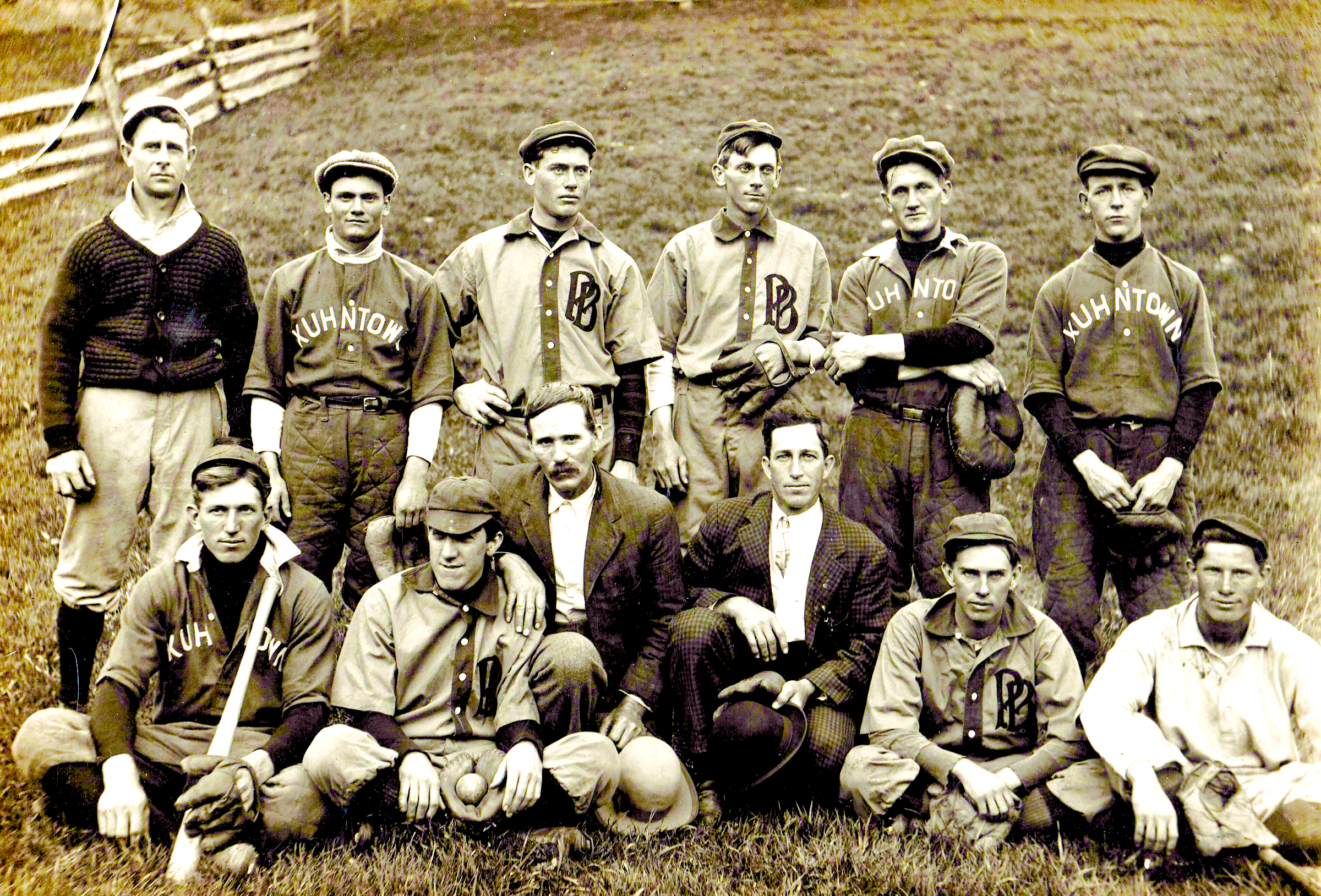
Ira “Budge” Tustin is considered one of the greatest players in county history. He started playing shortstop for Kuhntown at the age of 13. In 1915, he pitched for the Waynesburg Church League All-Stars against the Pittsburgh Pirates in an exhibition game. He gave up one run and three hits. The Pirates (and several clubs) repeatedly offered him contracts over the next decade, but Budge liked his job running the Kuhntown Post Office.
He did, however, barnstorm with Honus Wagner’s Yellow Cab team on his own schedule. In addition, he pitched for several county teams when the Homestead Grays came to town. He beat the Negro League legends three times, including a one-hit, 4-0 shutout while pitching for Mather.