


I’ll admit it. I’m not an avid soccer fan. I enjoy all sports, but soccer has never been at the top of my list. For men my age, soccer was not a thing when we were growing up – especially in Greene County.
Still, I found myself surprisingly entertained by this year’s World Cup and, more importantly, by some of the conversation surrounding it. Several analysts and former players made observations about the way young soccer players are developed in the United States that really resonated with me.
Their concerns echoed something I have been writing about for years: Participation shouldn’t come with a price tag, and a child’s chance to discover what he or she can do on a playing field shouldn’t depend on the size of a parent’s bank account.
That isn’t just a soccer issue. It’s a youth sports issue and one worth talking about, again. Ever since AAU teams, private academies, and shoe companies took over basketball in the U.S., the best players in the NBA come from other countries. (The top four players in the MVP voting were all international players).
People flock to see Japanese, Dominican, and Venezuelan players in MLB stadiums. The latter two countries are disproportionately represented (according to population) on major league rosters.
Because I grew up watching those sports, I was well aware of their current state. However, I never really thought about how our feeder system affected our soccer status in the world.
Just after the American soccer team was defeated by Belgium, I was listening to ESPN Radio. I heard something that struck a familiar chord with me. Landon Donovan, one of the greatest American soccer players in history, offered a powerful hypothesis on why our soccer failures continue.
He was talking about his own story. He grew up with a single mother who earned $34,000 a year while raising three children. Donovan said he would never have made it through the club system. His mother would not have been able to afford the fees and travel. Luckily for him, someone eventually stepped in and paid for his participation.
Think about that for a moment. One of the few great soccer players the United States ever produced only had a chance because of the largesse of family friend.
Alex Morgan, a Women’s World Cup champion, also pointed toward the youth system as our problem. “I think it’s all about the youth system. It’s been made a business.” That word — business — is important because soccer isn’t supposed to be a business to a 7-year-old. It’s supposed to be a game.

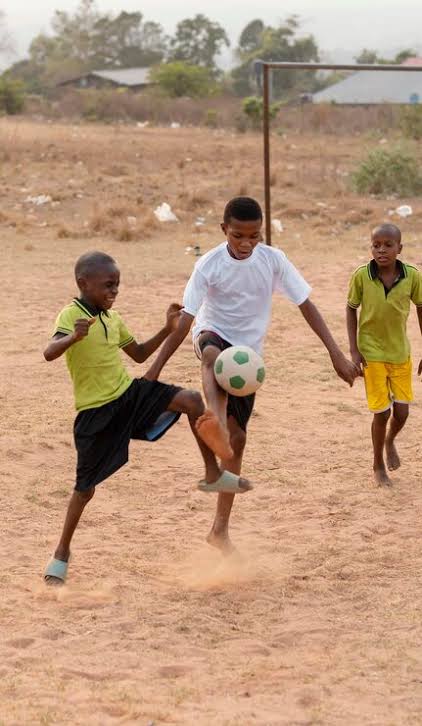
In many countries, all you need is a ball to have fun.
With more than 340 million people, enormous financial resources and some of the world’s best athletic talent, why isn’t the United States better at soccer? There are plenty of answers. But in my opinion, the biggest one starts with the greed that has taken over youth sports.
Just like most of our sports, American youth soccer has increasingly become a pay-to-play proposition. For families seeking the highest levels of competition, the costs include club fees, coaching, uniforms, registrations, hotels, gas and even air travel. What begins as a child’s interest in kicking a ball around becomes a substantial financial commitment.
Ultimately, there is something simple about soccer (maybe not the rules for old guys like me). But there is a ball, a patch of grass, a few kids, and a goal — which can be two cones on the ground, or whatever else happens to be available.
No expensive equipment is required. No set of bases. No helmets or shoulder pads. Just a ball and enough room to kick it around. For the rest of the world, that’s how soccer begins. In America, we’ve somehow managed to make it considerably more complicated and expensive.
A child in Brazil doesn’t need a travel league to fall in love with soccer. A kid in Argentina doesn’t need to understand the economics of club soccer before learning how to dribble. In countless communities around the world, children grow up playing wherever there is enough space. The neighborhood becomes the academy. There is no tryout fee, no hotel bill, no six-hour drive to a tournament. Just soccer.
That informal environment may be more important than we realize. When children play pickup games, they don’t necessarily play the way a coach tells them to play. They experiment and try things that might not work. That’s how creativity develops. That’s how instinct develops. It’s how a player learns to solve problems without waiting for a coach to tell him/her what to do.
But in America, at least we have become very good at organizing sports. We schedule everything. We travel hundreds of miles looking for better competition, and unfortunately coaches are chosen by which dad (or mom) is the best fundraiser.
I just don’t believe the best way to develop young athletes is to organize every minute of their athletic lives. Sometimes kids simply need to play. And they need to be able to play regardless of their parents’ income. Only about 2% of children playing organized soccer come from households earning less than $50,000 a year. How many potentially great players are we never seeing?
Think about the old neighborhood baseball games. Kids showed up at a field. Somebody brought a ball. Somebody else found a few cardboard boxes. The game begins. The same was true of the asphalt basketball courts in low-income communities. Kids showed up, called their own fouls, and developed toughness and learned hard lessons.
To be fair, pay-to-play isn’t the entire explanation for America’s athletic struggles. However, some of the other problems are a little more societally complex.
Fixing youth soccer won’t automatically turn the United States into Argentina or Spain. But expanding access gives America something it desperately needs: More chances to find exceptional players. And that’s the point.
The rest of the soccer world has spent generations allowing the game to grow from the bottom up. Children play because everybody plays. They play because it’s inexpensive. They play because it’s part of their culture. Unfortunately, America has tried to build soccer from the top down.
Perhaps we need to go back to the beginning. Back to the neighborhood. Back to the schoolyard. Back to the vacant lot.