


A drive along a country road, a walk through a cemetery, or a closer look at farm property in southwestern Pennsylvania will reveal several nut trees, some of them native to our area and others introduced. Pennsylvania does not have a state tree nut. The Pennsylvania state tree is the eastern hemlock, which produces inch-long, egg-shaped cones rather than nuts.
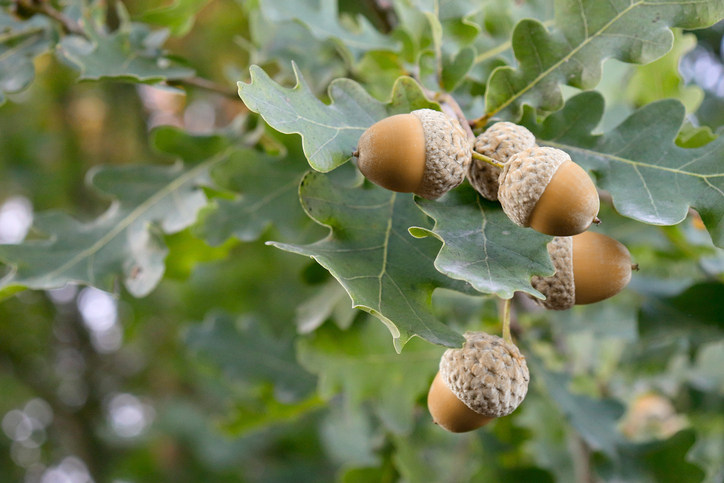
Oak trees are plentiful in our area and include white oak, northern red oak, pin oak and black oak. Oak trees produce acorns, which are the most abundant nut crop in North America. Even in an off-year, oaks produce more nuts than all other nut trees, both wild and cultivated, and were an important food source for eastern woodlands natives and European colonists. Evidence of acorn consumption has been traced back to the Paleolithic era.
Black walnut trees are native and abundant in our area. Easy to identify, these trees stand tall and can reach 80 feet. The bark is deeply furrowed and there is an absence of lower branches. Clusters of green nut husks form in the summer and are easy to see as this tree loses its leaves early in the fall. Black walnut trees can also be tapped for making syrup as you would a sugar maple. Nuts are harvested in late September and early October while the husks are still green.
Another native member of the walnut family is the butternut, also known as the oil nut or white walnut. These two nuts are stored and consumed by squirrels and gathered by humans for their distinctive taste for eating.
However, black walnuts and butternuts may not be good companions in the yard or near a vegetable garden. They produce a substance called juglone. This chemical, which is released through the roots into the soil, acts to eliminate surrounding plants which might compete for light, water, and nutrients. Juglone can be toxic to several plants including tomatoes, peppers, eggplant, and potatoes as well ornamental shrubs peony, lilac, rhododendron, and azalea. Juglone is most toxic under the drip line of the tree but can extend 50 to 80 feet from the trunk.
Two other well-known trees in western Pennsylvania are shellbark and shagbark hickories. The shagbark is distinctive by the appearance of its bark which appears to be peeling up and down the length of the trunk. It often grows in drier upland soils. The shellbark has smoother bark and produces larger husks and nuts. It prefers moist fertile bottomland. Hickory nuts have a milder taste than black walnuts and are prized for cakes and cookies.
I was in a doctor’s office some forty years ago and listened to a man tell an amazing story about his father, a lumberman, and the disappearance of trees up and down the east coast that were as big as the California redwoods. He was talking about the American chestnut. Numbering around four billion, these giants grew to be 100 feet tall and nine feet in diameter and were the most common tree in Pennsylvania until about 1904. A blight introduced in Japanese nursery stock was first detected at the Bronx Zoo. By 1940, most American chestnuts had been wiped out. The tree is considered technically extinct. The fungus that killed them still exists in the wild with trees only reaching the size of shrubs. The large chestnuts that we see today in their spiky husks are Chinese chestnuts. Research is currently being done at The American Chestnut Foundation in Louisville, Kentucky and Penn State University, among others, to restore this species.
Did you know you can grow pecans in Pennsylvania? Or that English walnuts came from Persia? Nut species that were once thought impossible for our area have been achieved by creating cultivars through grafting. Grafting is accomplished by taking rootstock from one species and grafting a section (called a scion) of another species onto it. This is called a cultivar and produces a tree with the best characteristics of each tree. Cultivars are hardier but more expensive to purchase. One example is the hican. Hicans are grown in Pennsylvania and are created by grafting a pecan to a hickory root stock. Nuts produced by native trees tend to be smaller and harder to crack than those produced by grafting. Ease of shelling, size, taste, and blight resistance are goals when creating cultivars.
Nut trees are planted with an eye for the long view. Most nut trees take about ten years to produce. In our state, filberts, or hazelnuts are the exception and produce a crop in about five years. As with every living plant, hardiness zone, soil composition and plant location are basic considerations. Trees need full sun and a deep, acidic, well-drained soil. Water is crucial especially in the first two years and weeds should be kept back at least four feet from the trunk, to hinder disease.
Trees are wind pollinated so that two trees of each variety should be planted. Chestnuts and walnuts require a genetically different chestnut or walnut to pollinate. The Northern Nut Growers Association [https://nutgrowing.org/] representing North America, and the Pennsylvania Nut Growers Association [http://pnga.net/] are good resources; the Pennsylvania Nut Growers offer grafting classes.
Soil testing kits and help from Penn State Master Gardeners can be obtained by contacting your local Penn State Extension office.