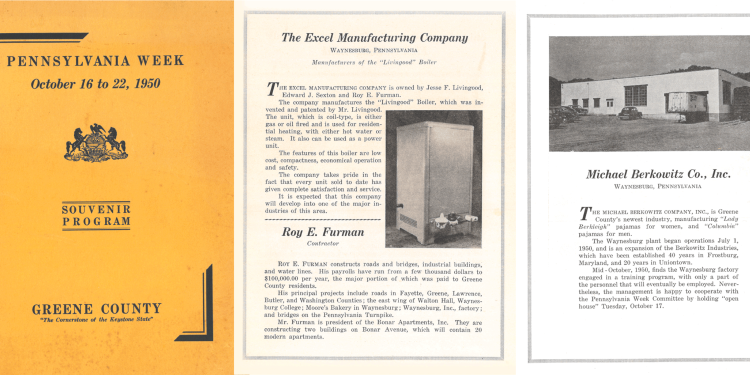


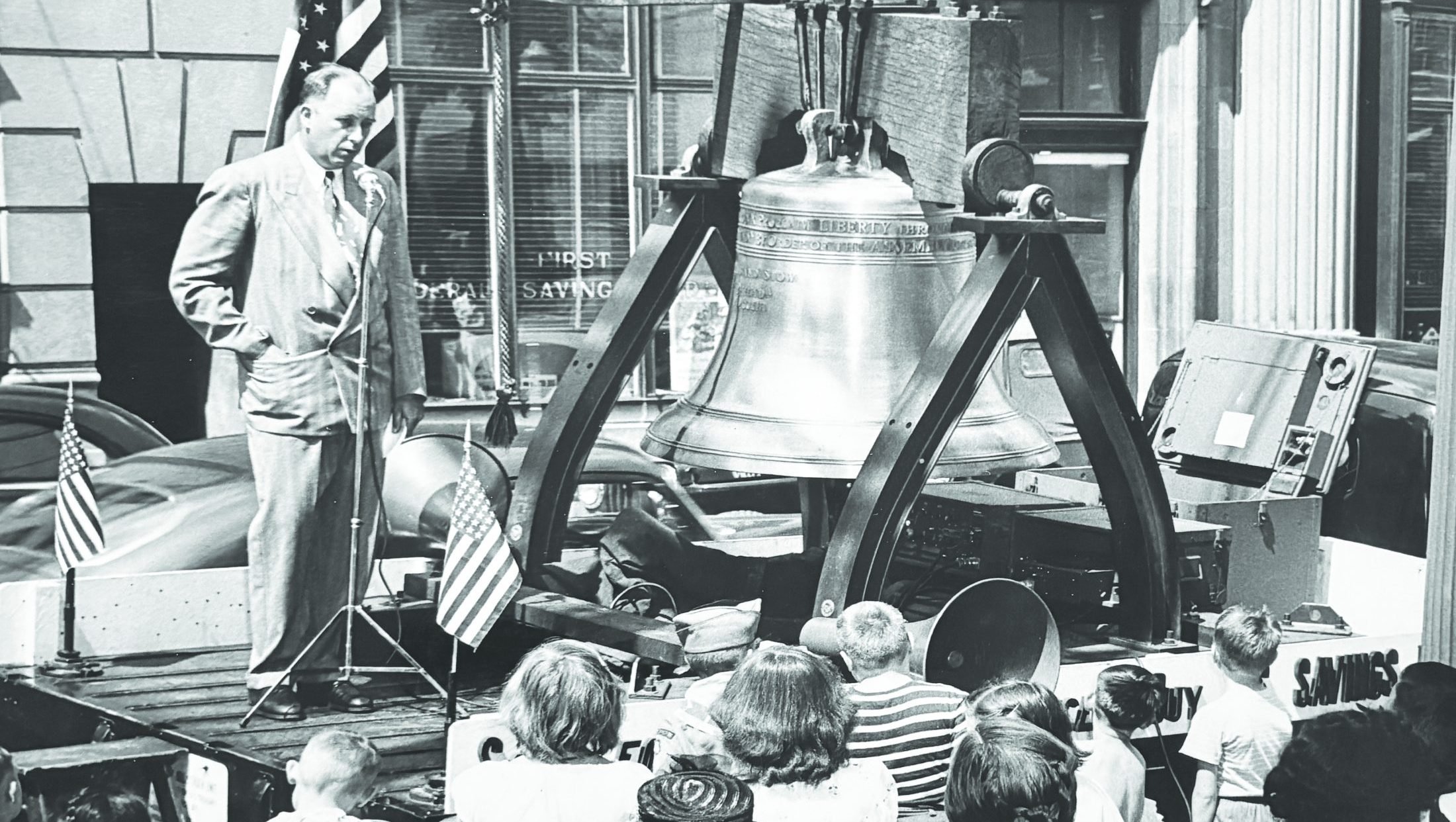
Burgess Maxwell addresses the crowd gathered around a replica of the Liberty Bell at a downtown celebration in 1950. (Photo courtesy of Greene County Chamber of Commerce)
When Greene County was established in 1796, southwestern Pennsylvania was still a developing frontier region. The county’s population was approximately 8,600 in the 1800 census. Over the next century, the number of residents grew steadily as settlers established farms, built communities and developed the local economy.
As communities such as Waynesburg and Carmichaels developed, they became centers of agriculture, commerce, government and social life. Population growth reflected the arrival of people seeking land and opportunity.

By 1850, Greene County’s population had surpassed 22,000. It continued to grow through the second half of the 19th century, reaching nearly 29,000 by 1890. The county had more than tripled its population.
The arrival of the 20th century brought new economic possibilities. Coal mining became increasingly important alongside agriculture, creating employment and stimulating business activity. The expansion of the coal industry in the 1920s and 1930s helped fuel another period of population growth (mostly Eastern European immigrants)
Greene County’s population rose from 30,804 in 1920 to 41,767 in 1930, an extraordinary increase of nearly 36 percent in a single decade. By 1940, the county had 44,671 residents, approaching the population record it would reach in 1950, which was 45,394.
Yet the decade that followed would bring a surprising reversal. While the United States experienced a postwar population boom, Greene County lost nearly 6,000 residents during the 1950s.
The results reflected changes in industry, technology, and education. Greene County’s experience was part of a larger transformation across traditional industrial regions. The story was not simply one of decline, but of a community adjusting to a world that was beginning to look very different.
Originally, the county’s agricultural and industrial traditions existed alongside one another, creating an economy rooted in the land and its resources. For many families, a livelihood was not something to be found hundreds of miles away. It was something inherited, learned and pursued close to home.
By the middle of the 20th century, however, the forces shaping American life were beginning to challenge that traditional pattern.
Mining supported far more than the people who worked underground. It generated business for transportation companies, equipment suppliers, merchants and other enterprises. The economic life of a mining community extended into its stores, churches, schools and neighborhoods. A mine’s success could affect the fortunes of an entire community.
During the middle decades of the 20th century, coal mining was undergoing significant technological and economic changes. Mechanization allowed companies to extract coal more efficiently, but it also reduced the need for certain types of labor. Greater production no longer required a proportionate increase in workers.
At the same time, energy markets were changing, and coal-producing communities faced new competitive pressures. The effects of the transformation challenged an economic system that had supported generations of workers.
When employment opportunities diminished, workers and their families sometimes had to look elsewhere. A reduction in local jobs affected merchants, service businesses and other employers whose fortunes depended on the spending of working families.
Obviously, the county’s coal industry did not disappear. Indeed, coal would remain an important part of our economy and later experience further development. But the relationship between coal production, employment and population was changing.
The population loss was striking, but it should not be mistaken for evidence that the county suddenly became an undesirable place to live. Population figures measure the number of people present, not the quality of their lives or the affection they felt for their communities.
Greene County was not alone in experiencing these pressures. Other parts of Pennsylvania, particularly older industrial and coal-producing regions, also lost population during the 1950s.
Economic change was only part of the story. American society was also developing a different understanding of what a successful life might look like.
Following World War II, the GI Bill helped many veterans attend college, expanding access to higher education for a generation of Americans. College had long offered a route into professional life, but postwar economic growth and the increasing demand for specialized skills made educational opportunities especially significant.
Attending college did not necessarily mean leaving permanently. Some graduates returned to their hometowns, bringing new skills and experience. Others found employment elsewhere and established their lives in growing metropolitan areas.
Either way, the relationship between a person’s birthplace and eventual occupation was becoming less direct. Earlier generations often entered the same trades or industries as their parents because those occupations were familiar, accessible and locally available.
The places attracting Americans were changing, too. During the postwar decades, metropolitan areas expanded, highways improved access to employment centers, and suburban communities grew rapidly.

The South was also beginning a long period of economic and population growth. Over time, manufacturing, military installations, and emerging technology industries helped expand employment and redistribute the nation’s population.
Despite these trends, the county’s population remained incredibly steady for four decades. It was 39,108 in 1970, rose to 40,476 in 1980, and reached 40,672 in 2000 before declining again. By the 2010 census, the county had 38,686 residents. However, in 2020, it dropped precipitously to 35,954.
Those figures represent a long-term change, but they do not tell the whole story. Population totals cannot measure the strength of family ties, the value of community institutions or the commitment of residents who chose to remain. Nor do they capture the contributions of people who left but maintained connections to the place where they grew up.
The county continues to evolve, as agriculture, energy production, education, health care, and other economic activities shape our communities in different ways. Our history is not a straight line from prosperity to decline, but a series of adjustments to changing circumstances.
Still, the numbers invite reflection. Some communities have changed in appearance and character; others retain familiar landmarks and traditions. Generations have come and gone, and the definition of a local livelihood has broadened.
In 1950, Greene County reached a population level it has not regained. That fact is a useful historical marker, but it need not be treated as a verdict on the county’s present or future.
The people who left carried their experiences, memories and connections with them. Those who stayed continued the work of maintaining communities rooted in generations of shared history.
Perhaps that is the most revealing part of the story. Our people cannot be measured by census figures alone. A hometown can change, grow quieter or become less crowded without losing its place in the lives of those who call it home.