

There are places on a map, and then there are places that exist in the memories of the people who grew up there. West Waynesburg is both. Officially part of Franklin Township and immediately west of Waynesburg, the community has also long been known by another name: Bucktown.
The origins of the nickname are generally traced to the Buchanon family, whose property once occupied much of the area. Today, West Waynesburg is close enough to downtown Waynesburg that the two can seem almost inseparable. But for generations, Bucktown had its own identity.
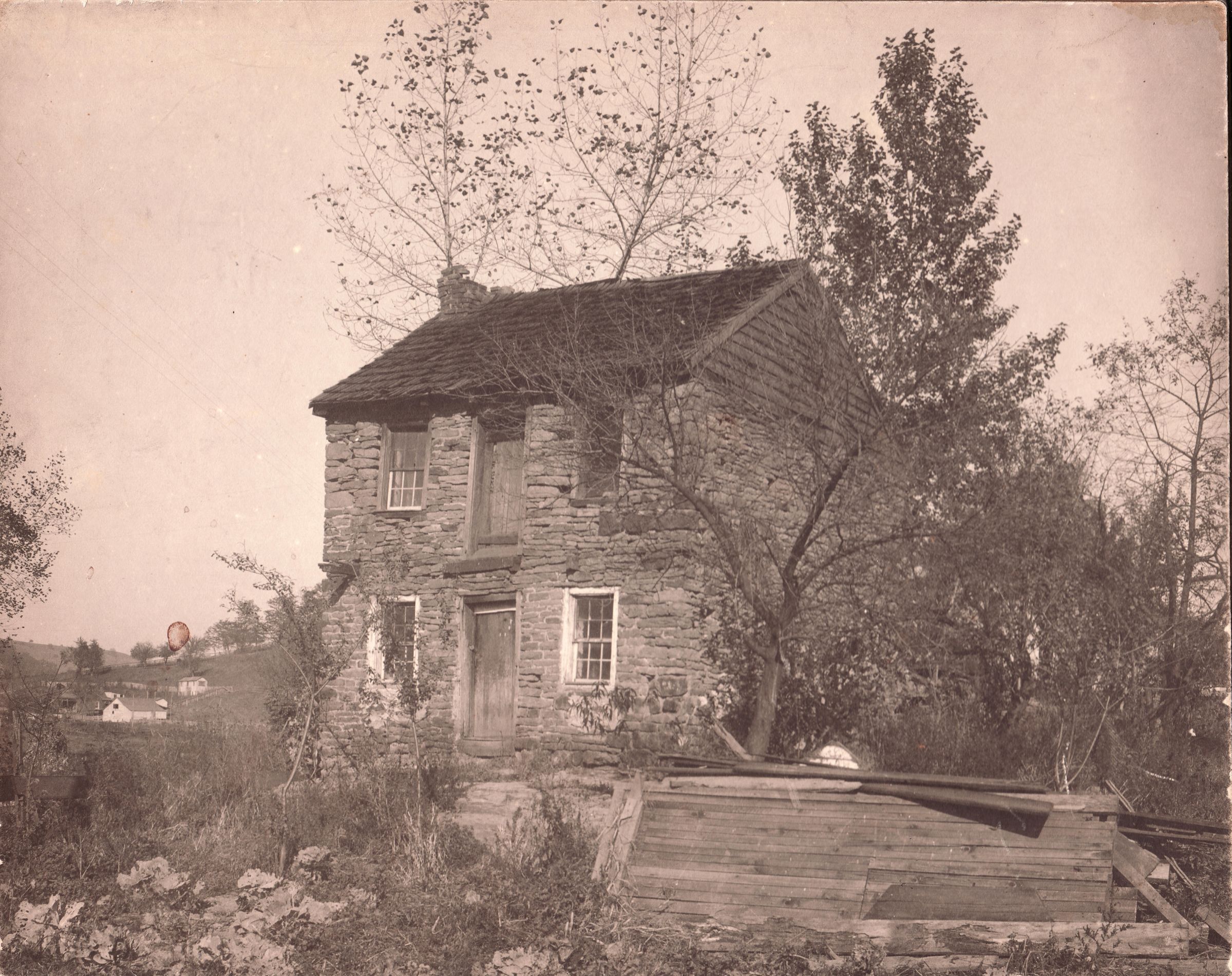
The area was originally settled by the Brown family and their son-in-law Captain James Seals. Seals was a veteran of both the Revolutionary and Indian Wars. Because of his efforts and valor, he was appointed as one of the original county commissioners. He built a “fine stone house” at the bottom of Toll Gate Run (originally named Bloody Run, then Brown’s Run). Some people are old enough to remember the neglected ruins of the structure.
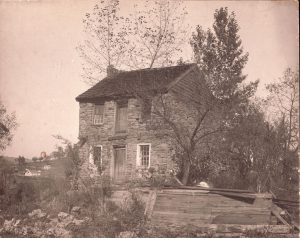
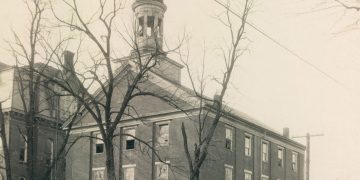
James Seals’ West Waynesburg stone house before industrialization changed the landscape forever. (The Greene County Historical Society’s Collection; Greene Connections Archive Project)
A century later, the area’s identity was shaped by the new railroad and emerging industries.
The arrival of the Waynesburg & Washington Railroad in 1877 helped transform West Waynesburg from a largely rural area into a small industrial and commercial center. The railroad station was known as Buchanon and the line once terminated there.
The company had run out of money, and it would be another seven years before the line extended to the southside of Waynesburg. A small industrial complex developed around the station.
One of Bucktown’s lesser-known chapters involved the steel industry. During the early decades of the twentieth century, a steel fabricating operation in West Waynesburg provided high paying jobs for several hundred residents and reflected the industrial optimism of the era.
Although it never approached the size of Pittsburgh’s steel mills, it represented a period when communities throughout southwestern Pennsylvania sought to diversify their economies while still relying on the natural resources that surrounded them.
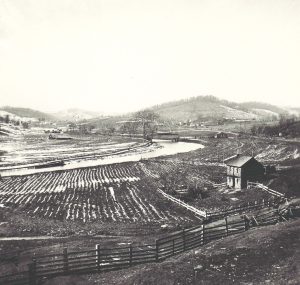
Early image of pre-industrial West Waynesburg (Courtesy of Greene Connections)
The Griffith Tin Mill operated there at the turn of the 20th century and provided several hundred high paying jobs for locals. It was an important part of the community’s working identity. However, the Panic of 1907 and the collapse of the Farmers and Drovers Bank sent the mill into receivership.
After a couple of ownership changes, the mill was bought by the American Steel Company and continued operations until 1925. The company sponsored one of the premier baseball teams in the county in the early twenties.
However, the story did not end with the mill’s closing. The industrial buildings found other uses, and the site later became associated with the livestock auction. The old industrial property therefore continued to serve the community, although the products moving through it had changed dramatically.
Despite the rise of mining operations in the early part of the 20th century, agriculture remained central to everyday life. Farmers from every corner of Greene County regularly traveled to Bucktown’s stockyards, where livestock auctions became fixtures on the local calendar.
The location became a familiar landmark for generations of residents. Even businesses located nearby were identified by their relationship to the stockyard. When Wayne Lumber began operating in West Waynesburg after World War II, for example, the company established itself as the old feed store “in front of the stockyard.”
On sale days, the roads and surrounding area took on a different character as farmers arrived with animals. For many people, however, the stockyards were about more than buying and selling animals. Like a general store or a feed mill, the auction was a place where people saw neighbors, exchanged news and maintained connections. It was part of the informal social infrastructure of rural Greene County.
Baseball provided another important piece of West Waynesburg’s identity.
Even before the land became associated with Emerald Mine, boys from the area played baseball on what became known as Emerald Field. The field itself operated for roughly two and a half decades on coal-company property and became one of the area’s premier youth baseball facilities. It hosted thousands of baseball games and tournaments, including a 1970 men’s state softball tournament.
Waynesburg’s Knee-Hi baseball league started in the early 1950s. The Bucktown Buccaneers were charter members of the league along with the Morrisville Giants, the East End Wildcats, and the Waynesburg Lions.
However, the earliest games I could find being played at “Emerald Field” were Pony League games in 1957. One of the seven teams in the league was the Waynesburg Optimist Club. This would seem to validate an anecdotal source who told me his father was a member of the Optimist Club in those days and had mentioned they had built Emerald Field.
Several generations can remember passing through the rickety old steel bridge across the Ten Mile to emerge at a beautifully maintained ballfield replete with a broadcasting booth for WANB and an outfield fence covered in permanently painted advertisements.
Then in the early 1980s, the coal company reclaimed the land for the construction of Emerald Mine. The baseball field disappeared beneath the changing landscape, leaving behind memories for the generations who had played there.
Baseball, however, survived. A new Emerald Field was eventually developed in 1985. The present complex includes two pony-league baseball fields. The history of Emerald Field is therefore a fitting illustration of West Waynesburg itself. The land and industries changed, but the community continued finding ways to put the property to use.
For others, summer entertainment meant heading to the Waynesburg Drive-In, which we covered in detail in last month’s issue. The drive-in opened June 29, 1950. Its opening attraction was Boy from Indiana, and the theater eventually accommodated about 300 automobiles.
The big screen, the rows of cars and the glow of headlights arriving and departing became part of the landscape of West Waynesburg. Like many drive-ins across America, the theater eventually disappeared, but the memories remain remarkably durable.
Not every West Waynesburg memory involved work or organized recreation. Some involved little more than a fishing rod, a quiet stretch of water and time to spare.
Bucktown Dam on Ten Mile Creek became another familiar landmark. The dam is still recognized as a local access point to Ten Mile Creek, and the creek now attracts those interested in the outdoors. A modern four-mile kayaking route begins at Bucktown Dam and follows Ten Mile Creek through Waynesburg.
But long before kayaking became a recreational activity, the water was a place for fishing and simply getting away from the noise of town. The creek was part of the neighborhood’s geography and, consequently, part of its memories. In my research, I found even ice hockey games and team swimming events were common occurrences.
West Waynesburg has experienced many of the changes that have shaped Greene County over the past century and a half. The railroad became less important. The tin mill disappeared. The livestock auction became a landmark of a different kind. Coal mining changed the landscape. The old drive-in vanished. Ball fields moved and were rebuilt.
Yet the name Bucktown remains. That may be the best measure of a community’s identity. Places change, buildings disappear and businesses come and go, but names survive because people attach memories to them.
Acknowledgements: History of Greene County, Pennsylvania (Smith), Three Feet on the Panhandle (Koehler & Gayvert) and the Greene County Genealogical Society staff.