


I remember the first Earth Day like it was yesterday. I was in fifth grade at East Franklin, and we wrote an essay about the significance of the celebration in Mrs. Neubauer’s Language Arts class. Then we went outside and planted a tree near her classroom window. Fifty-six years later, Mrs. Neubauer and I are still going strong, but I can’t say the same for Earth Day. (I’m not sure about the tree.)
Earth Day began not as a symbolic holiday, but as a mass civic uprising rooted in crisis. Its origin story is inseparable from the environmental emergencies of the late 1960s. On the first Earth Day (April 22, 1970), Americans were responding to visible, visceral signs that the postwar industrial boom had come at a staggering ecological cost.
In 1962, the publication of Silent Spring by Rachel Carson exposed the dangers of indiscriminate pesticide use. Her work translated scientific findings into moral urgency, showing that chemical contamination was not an abstract issue but a direct threat to human health and wildlife. The book sparked public debate, congressional hearings, and eventually regulatory reform.
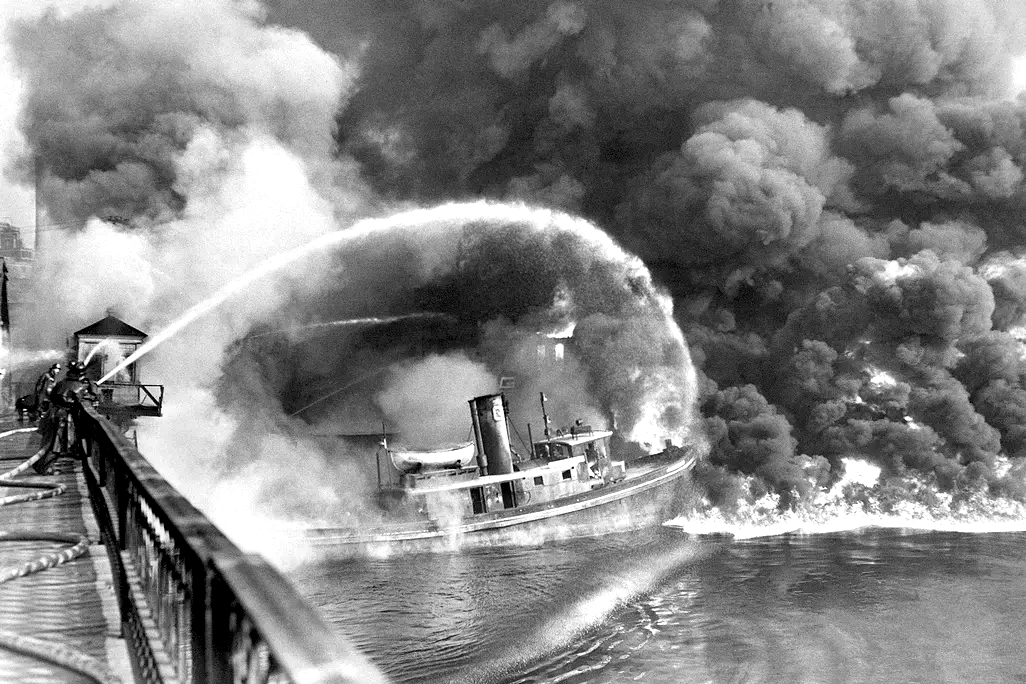
The late 1960s delivered dramatic images that reinforced this message. In 1969, the heavily polluted Cuyahoga River in Ohio caught fire due to industrial waste floating on its surface. The national media coverage turned that episode into a symbol of environmental neglect.
That same year, a massive oil-spill off the coast of Santa Barbara coated beaches and wildlife in crude oil, horrifying viewers across the country. Smog blanketed cities like Pittsburgh, Los Angeles and New York. Lakes were declared biologically dead. The costs of unchecked growth were no longer invisible.
It was against this backdrop that Senator Gaylord Nelson conceived of Earth Day. He envisioned a nationwide environmental teach-in that would harness grassroots energy. He recruited young activists to coordinate the effort. The date—April 22—was strategically chosen to maximize student participation, falling between spring break and final exams.
The response exceeded expectations. That day an estimated 20 million Americans—roughly one in ten—participated in rallies, marches, and educational events. Republicans and Democrats, urban and rural communities, labor unions and conservationists found common cause. Earth Day was not initially partisan. It was framed as a defense of public health, shared natural heritage, and intergenerational responsibility.
The political impact was swift. By the end of 1970, Congress had authorized the creation of the United States Environmental Protection Agency (EPA). Landmark legislation followed: the Clean Air Act (1970), the Clean Water Act (1972), and the Endangered Species Act (1973). President Nixon, not typically associated with environmentalism, signed all these measures into law. The 1970s marked a rare period when environmental protection was widely seen as compatible with economic prosperity and national strength.
But the environmental emphasis of the 1970s was not only about regulation. It reflected a broader cultural shift. The decade saw the rise of ecological thinking in schools, media, and popular culture. The first Earth Day was embedded in a worldview that questioned reckless growth and technological hubris.
Citizens believed democratic pressure could restrain corporate pollution and reshape national priorities. The narrative was clear: human activity had destabilized natural systems, but public action and government intervention could restore balance. Environmental protection was patriotic, pragmatic, and morally urgent.
So why does that narrative feel lost today?
Part of the answer lies in economic and political shifts that began in the 1980s. Environmental regulations were increasingly portrayed as burdensome constraints on growth. Regulatory rollback became a central policy objective. Environmentalism was reframed as anti-business, rather than as a defense of shared public goods.
At the same time, environmental challenges grew more complex. The smog and burning rivers of 1970 were visible and local. Climate change, biodiversity loss, and ocean acidification are diffuse and global. It is easier to rally around a river on fire than around rising atmospheric carbon concentrations. The immediacy that galvanized Earth Day’s first generation has been replaced by abstract data, models, and long-term projections.
Media fragmentation has also altered the landscape. In 1970, Americans consumed news through a handful of national outlets. Shared images created shared outrage. Today’s media ecosystem is more polarized and segmented. Environmental issues often become entangled in partisan identity rather than framed as universal concerns.
Yet the narrative is not entirely lost. Earth Day is now observed globally, involving more than a billion participants across countries and cultures. The language of planetary boundaries and environmental justice has deepened the conversation, linking ecology with equity and human rights.
What may be missing is the unifying story that once cut across ideology. The first Earth Day framed environmental protection as common-sense stewardship. It emerged from tangible crises that transcended party lines. Today’s environmental discourse often feels technocratic and apocalyptic. While urgency remains, consensus has frayed.
Recovering the spirit of 1970 does not mean romanticizing the past. The early environmental movement had blind spots, but it did succeed in forging a broad civic coalition around the idea that clean air, clean water, and a stable climate are foundational to human existence.
The origin of Earth Day reminds us that narratives matter. History demonstrates that collective action can produce measurable results. The challenge for the present generation is to recover the sense of shared purpose that once made twenty million people take to the streets for the air they breathed and the water they drank.
Whether the narrative is truly lost, or simply waiting to be reframed, depends on how societies choose to tell the story of their relationship with the Earth in the decades ahead.