


College football bowl games began as a civic-minded business idea. The idea was to attract tourists during the quiet winter months.
The “Grandaddy of them all,” the Rose Bowl, was first played on January 1, 1902, in Pasadena as part of the city’s annual Tournament of Roses festivities. Organizers hoped to draw national attention and bolster the local economy by staging a football game between two of the nation’s best college teams — Michigan and Stanford.
The game was so one-sided, with Michigan winning 49-0, that the football experiment was shelved for over a decade. But in 1916, the Rose Bowl returned for good, and its success inspired a century-long evolution of postseason college football.
For many years, the Rose Bowl stood alone as the only postseason contest, serving as a prestigious matchup between champions from the East and West. But as football grew in popularity throughout the 1930s, other regions sought their own winter showcases.
The Orange Bowl in Miami (first played in 1935), the Sugar Bowl in New Orleans (1935), and the Cotton Bowl in Dallas (1937) followed, each designed to promote tourism in their respective cities. These “New Year’s Day Classics” became powerful regional institutions, blending sports, civic pride, and holiday celebration.
By the 1950s, bowl games had become a defining feature of college football. Television helped expand their reach. The 1952 Sugar Bowl was the first to be broadcast nationally. Bowl invitations soon became badges of honor for successful teams, while fans across the country embraced the tradition of tuning in to multiple games on New Year’s Day.
The four major bowls formed the core of what would be known as the “New Year’s Day lineup,” synonymous with college football’s biggest stage.
In the 1960s, the Peach, Sun, Tangerine, Citrus, and Fiesta Bowls joined the party. While usually lacking the true blue bloods of college football, the participating teams were usually schools that posted impressive records or featured a star player the country wanted to see.
Unfortunately, the explosion of bowl games came later. As cable television and corporate sponsorships expanded in the 1980s and 1990s, new bowl games emerged across the nation. Smaller cities realized that hosting a bowl could generate tourism dollars and national exposure.
Today, more than 40 bowl games are held annually, stretching from mid-December through early January. This is the part of the column where I thought I would make up funny fake bowl names. However, after looking up the list of REAL bowl names and realized I couldn’t make up anything dumber.
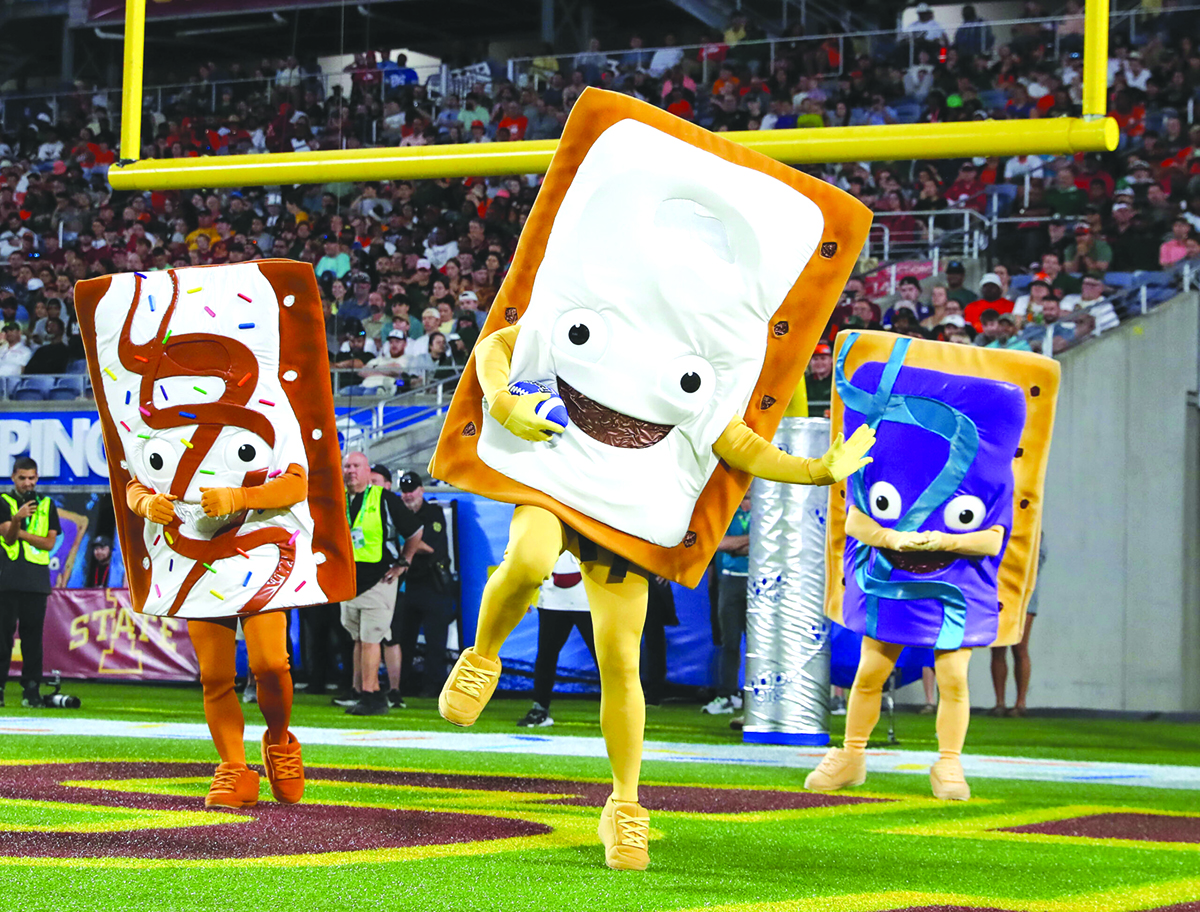
We are currently subjected to the Pop-Tarts Bowl, The Tony the Tiger Sun Bowl, the Duke’s Mayo Bowl, the Wasabi Fenway Bowl, and the Snoop Dogg Arizona Bowl Presented by Gin and Juice.
These enthralling matchups feature teams who scheduled just enough cupcake schools to struggle to a 6-6 record. Who needs to watch the best teams battling in primetime at top-tier idyllic locales when you can watch Southwest Billybob State take on Valparaiso University on a Tuesday night in Shreveport in the Mildly Adequate Bowl?
In this era of corporate creativity, someone decided fans needed the TaxSlayer Gator Bowl, as if nothing screams “tradition” like aggressive financial planning. Today, bowl eligibility is basically the participation trophy of college football.
As much as we rail against this absurdity, it’s our own fault. Just like the people who still pay their hard-earned money to watch the Pittsburgh Pirates, we enable this morass of mediocrity by watching it. It’s a hopeless addiction we support by our unwavering devotion and love of a nostalgic ideal from our past.
Bowl season may be absurd, overgrown, and shamelessly commercial, but we tune in. We watch because it’s cold outside, because most of the teams we root for around here are in those bowls, and because any football is better than watching the NBA.