


It was a cold and windy morning. Christmas was coming, and everyone in and around the Waynesburg area waited with anticipation for something big that holiday. But instead of the peace and joy that we long to surround the Christmas season, December 23, 1925, came with a rage that took an entire community by storm.
About 3:30 that early morning, a fire was said to have ignited in a hotdog stand dinette called the Coney Island Restaurant in the well-known hotel and business-hub, the Downey House.
An earlier anniversary observance of the Downey House Fire in the Greene County Messenger explains that the whole region was “shocked, frightened, and stunned by the tragic blaze.”
Standing a stately three stories tall and spanning a block on the southwest intersection of Washington and High Streets, the Downey House was an icon for locals and travelers alike. The building housed over 50 businesses at its peak, and was a bazaar of shops, department stores, supermarkets, eateries, and, of course, 60 guest rooms.
Opened in 1869 by R.F. Downey, the hotel was being operated by his two lawyer sons, Frank and Robinson, at the time of the fire.
When flames penetrated the restaurant walls of the Downey House and its numerous other rooms, guests and onlookers began to take note. As the blaze raged on, sparks multiplied and eventually danced their way to 25 other local buildings and businesses outside the Downey House walls. As winds whipped, the fire eventually destroyed the First Presbyterian Church that stood in the lot now occupied by the Observer-Reporter Building. Not even the statue of General Nathaniel Greene atop Greene County’s Courthouse cupola was safe. But far more devastating was the loss of five brave lives of men who fought to ensure the safety of their neighbors, despite the cost.
Greene County journalist John O’Hara wrote that the five men who passed “were trapped when the wall of the four-story Grossman Building suddenly cascaded down upon them and were hopelessly pinned under tons of brick and concrete.”
We hardly hear much beyond the names of those lives that are lost to unfortunate events such as this. These small biographies shed the tiniest glimmer into who these men might have been: Harvey Call, Jr., at 22 years of age, was the president of the eponymously named Grocery Company. William Finch studied at both Waynesburg High School and Penn State University by his 25th birthday. Thurman Long was a married man of 30 from Morgan Township. Joseph Rifenbur served as a contractor for W.K. Reed at 21 years of age. Victor H. Silveus was a 24-year-old married man at the time of his death.
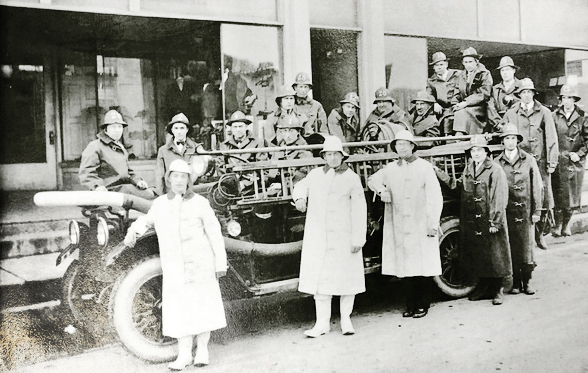
This December marked the 100th anniversary of the Downey House Fire, an event remembered with sorrow by our community. But as a result, this December also marks the start of Waynesburg’s own Volunteer Fire Department.
Until this tragedy occurred, Waynesburg had not had a fire company of its own since 1884, and utilized primitive bucket-brigade tactics, assembled by whoever might not be engaged in other matters when the courthouse bell would peel.
Responders to the Downey House Fire hailed from a myriad of departments across Greene County and beyond, including Rices Landing (who had just obtained their first truck a day prior), Nemacolin, East Washington, Charleroi, Carmichaels, Jefferson, Fredericktown, Masontown, Brownsville, Bentleyville, and even Buckeye Mine’s own response crew.
Afterwards, the borough of Waynesburg wasted no time assembling the proper leadership and equipment for more effectively fighting fires in the years to come. By March 4, 1926, Marshall D. Wood was selected as the first fire chief, rather than that responsibility falling on the already over-burdened police chief as at the time of the Downey House Fire.
The department was officially incorporated on December 28, 1926. Soon after the fire, the borough purchased an American LaFrance 750 gallon-per-minute pumper for $12,500, according to G. Wayne Smith, author of “Fighting Fires in Waynesburg, 1883-1925”.
Mere weeks after the monumental building fell, a group of like-minded Waynesburgers purchased the land where the Downey House stood and began construction on another recognizable Waynesburg building– the Fort Jackson Hotel that still stands today, albeit as office buildings rather than in its original capacity.
In 1967, the ruins of the Downey House that remained standing were torn down with mixed emotions from the community. Many passers-by even wept when the wrecking ball came for the final bricks of the last century.
In 1976, former Waynesburg Fire Chief R. Clovis Wright was interviewed regarding his involvement in response to the Downey House Fire. Wright was one of the nine volunteers on the hotel roof when the walls came crashing down and lived to tell a piece of this heroic tale. He shared that, “One of the doctors in Waynesburg was over at the hospital at the time…and he cleared the hospital of all the patients that were able to go home,” in order to prepare a place for the large number of individuals requiring immediate care.
Chief Wright went on to explain that the fire was fought with water alone, without the aid of foaming agents that are typically recommended today, leading to great challenges in putting out the blaze that raged for over six hours.
These perspectives demonstrate the far-reaching scope of The Downey House Fire: this wasn’t just an event that mattered in 1925. Instead, it ignited positive change that we continue to benefit from today.
**Many thanks to David Cressey and the entire research staff at Cornerstone Genealogy Society, housed in Waynesburg’s first courthouse, for bringing this event to life, and to those first responders who continue to serve our community and beyond.