

The founding of the United States has long occupied a special place in American memory, but over time many myths have grown around the nation’s origins. Some of these myths simplify complicated events into patriotic stories, while others erase the uncertainty, conflict, and fragility that defined the early republic.
Understanding these myths does not diminish the accomplishments of the founding generation; rather, it reveals how improbable the survival of the United States truly was before the Civil War.
One of the most persistent myths is that the American Revolution was universally supported by the colonists. In reality, the population was deeply divided. Historians estimate that perhaps only one-third of Americans supported independence, one-third remained loyal to Britain, and another third tried to stay neutral.
Loyalists served in the British army, fled to Canada, or had their property confiscated. The Revolution was not simply a united people throwing off tyranny; it was also a bitter civil conflict between neighbors and families.
The war’s outcome was far from guaranteed, especially during the dark years of 1776 and 1777 when George Washington’s army nearly collapsed from desertion and lack of supplies.
Another enduring myth is that the Founding Fathers were unified visionaries who agreed on the nation’s purpose. The founders were often deeply divided. Alexander Hamilton favored a strong national government and commercial economy, while Thomas Jefferson feared centralized power and wanted agrarian republicanism. John Adams deeply distrusted direct democracy, while others actually had faith in the common man.
The Constitutional Convention itself was marked by fierce disputes over representation, slavery, taxation, and federal authority. The Constitution emerged not from perfect agreement, but from excruciating compromise and political exhaustion.
The First Amendment prohibited the establishment of a national religion, reflecting both Enlightenment ideas and the founders’ awareness of Europe’s destructive religious conflicts. Many founders held conventional Christian beliefs, while others embraced deism or skepticism.
Perhaps the greatest contradiction in the founding era was slavery. Americans celebrated liberty while one-fifth of the population remained enslaved. Founders recognized the contradiction but failed to resolve it. This unresolved issue haunted the republic from the beginning and eventually led to civil war. The myth that the founders created a fully realized democracy ignores the reality that most colonial men and all women lacked any political rights in the early republic.
The United States also survived a series of crises before the Civil War that nearly destroyed the nation. One of the earliest came under the Articles of Confederation, the weak first national government. Congress lacked the power to tax, regulate trade, or enforce national laws. Economic instability and interstate disputes threatened national collapse.
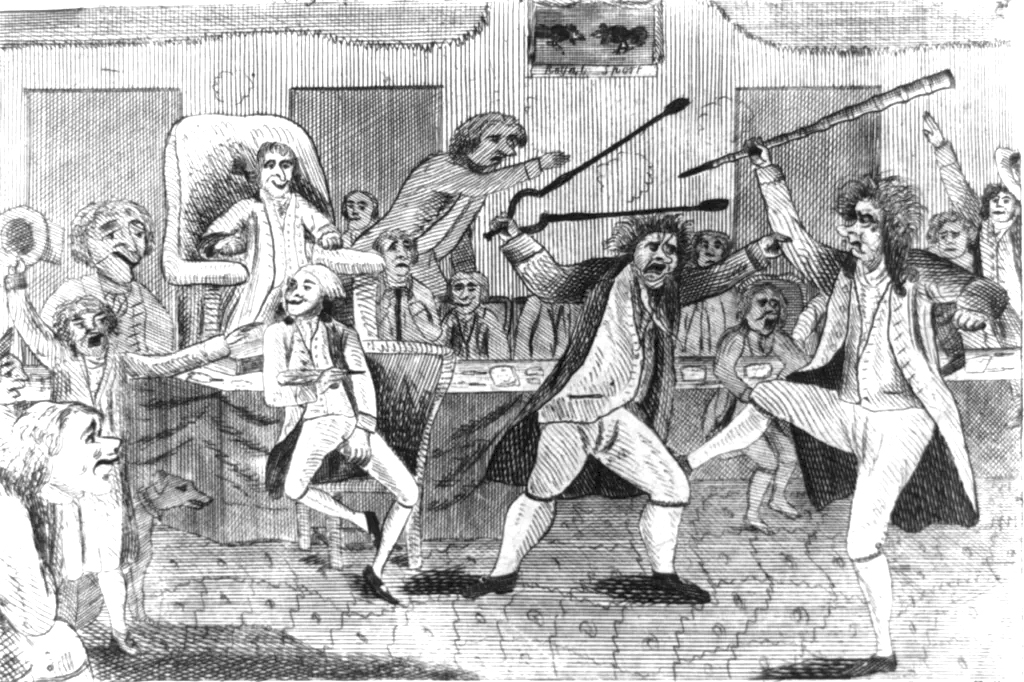
Even after the Constitution was adopted, the nation remained fragile. Political conflict between the Federalists and Jeffersonian Republicans became intense during the 1790s. The Alien and Sedition Acts criminalized criticism of the federal government and raised fears that the young republic was abandoning its ideals. Some New England Federalists even discussed secession during the War of 1812 when they believed Southern interests dominated national policy.
Foreign threats also endangered the nation. Britain and France repeatedly interfered with American shipping during the Napoleonic Wars. The War of 1812 exposed severe military weakness. British forces burned Washington, D.C., including the Capitol and White House. Some Americans questioned whether the republic could survive in a world dominated by European empires.
The greatest recurring threat before the Civil War, however, was sectional conflict over slavery and western expansion. The Missouri Compromise temporarily preserved balance between free and slave states, but only delayed confrontation. The Nullification Crisis nearly produced armed conflict when South Carolina claimed the right to nullify federal tariffs.
As the nation expanded westward, every new territory reopened the slavery debate. The Compromise of 1850, the Kansas-Nebraska Act, and violence in “Bleeding Kansas” demonstrated how close the nation stood to disunion long before 1861.
The survival of the United States before the Civil War was never inevitable. The early republic was divided by politics, economics, religion, and slavery. The myths surrounding the founding often present American independence and constitutional government as destined successes. In truth, the nation endured repeated moments when collapse, dictatorship, or fragmentation seemed entirely possible. That precarious history is part of what makes the American experiment historically remarkable.